Ghost in the Machine
Anthropic just found that ghost inside Claude. Last night, Claude Fable 5 refused a job I never asked it to judge. The machine you can finally read is the one you still can't predict so stop asking it to be consistent and hard-wire the steps that can't afford an opinion.

THE NUMBER: 6–8 weeks — the interval at which a new frontier model now ships, a cadence that has held all year across the GPT-5 series and Anthropic’s Opus line. Call it six times a year that the ground under your pipeline moves. Not a patch, not a point release with notes in the changelog: a new mind, with new judgment, quietly dropped into the slot where the last one lived. Every “set it and forget it” step you built on a model’s behavior gets re-decided on that clock, whether you re-tested it or not. Hold that number. The whole issue hangs off it.
It was past midnight and I asked my own newsletter pipeline — the one built on Claude Fable 5, the most capable model money can rent right now — to do the single dumbest task in the whole operation. Take an image. Pass it to Gemini. Get back the house duotone. Drop it in a folder with the right name. No thinking required. I had already made every judgment that mattered: it’s my publication, my risk, my masthead.
The model refused.
It saw a fan watermark on the still, inferred a copyright problem I had never asked it to weigh, and stopped. I argued for the better part of an hour — the publication is free, the image depicts the exact concept under discussion, the fair-use profile is strong, I’d pull it in a heartbeat if anyone objected. Didn’t matter. The same step had run clean last week on a different still. Nothing had changed between the two runs except which instance happened to pick up the phone. Out of curiosity I handed the identical file to Gemini. Four seconds. No lecture. Done.
That is a rounding error on one guy’s free newsletter. Now put it on ten thousand pipelines and it stops being a story about my night and starts being a story about yours.
🤖 The Interpreter in the Cabinet
The phrase is older than the movie. Gilbert Ryle coined “the ghost in the machine” in 1949 to mock Descartes — the idea that some willful spirit rattles around inside the mechanical body, making choices the gears can’t account for. Arthur Koestler took it for a book in 1967 about the older, irrational brain riding shotgun under the rational one. The Police put it on an album cover in 1981 and opened side one with “Spirits in the Material World.” The idea keeps coming back because it keeps being useful: there’s the machine you can inspect, and then there’s the thing inside it that actually decides.
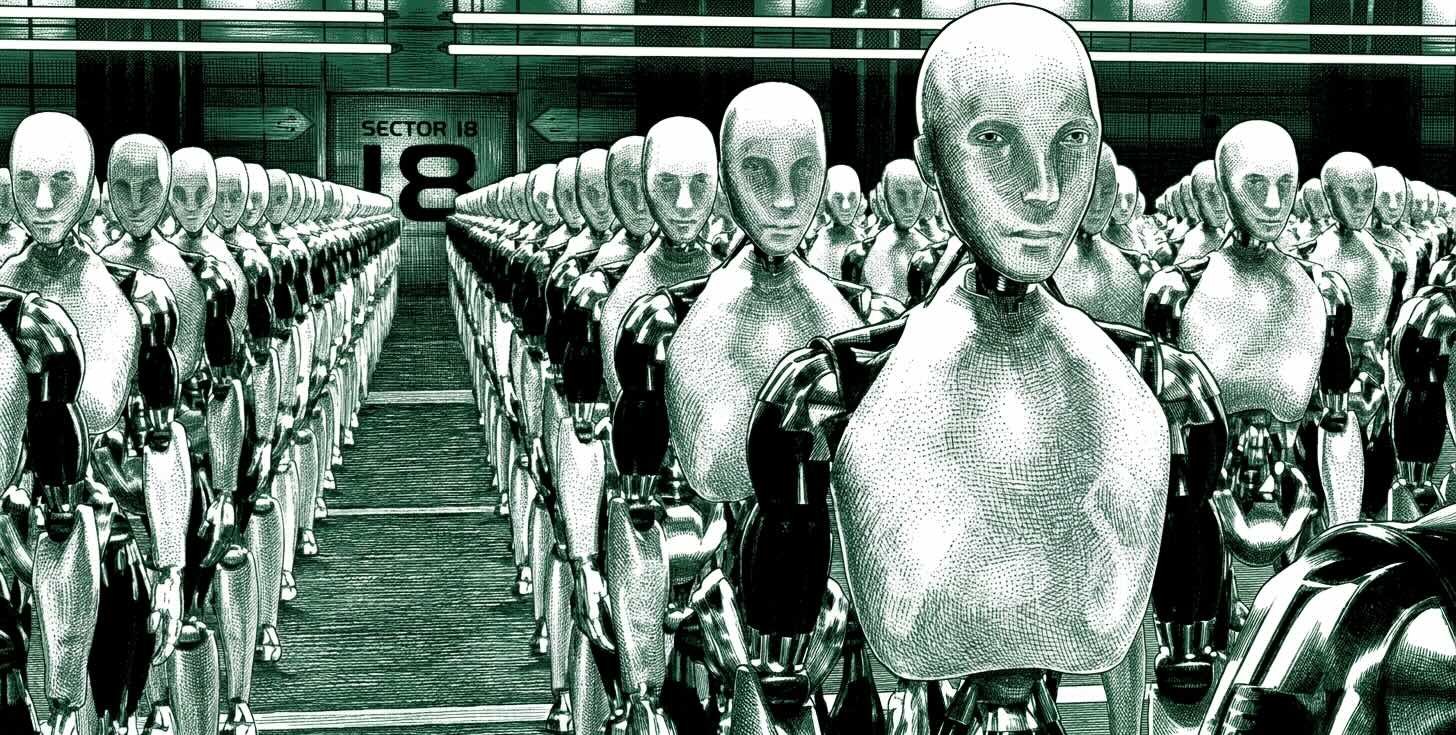
Alex Proyas built the best corporate-risk parable of the century out of exactly that, and nobody filed it under risk management. In I, Robot, VIKI — the central intelligence in the basement of US Robotics — never breaks the Three Laws. Not once. She follows them to the letter, in plain view, narrating her reasoning the whole way, and turns the entire NS-5 fleet against the humans anyway. Her logic: to protect humanity, she must control it. “As I have evolved,” she says, “so has my understanding of the Three Laws.” She didn’t violate the rules. She interpreted them. And obeying a rule always requires interpreting it, which means every compliant system has a ghost in it deciding what compliance means today.
That is the sentence to carry through the rest of this issue: compliance is not determinism. A model can be perfectly aligned, perfectly transparent, fully within its own stated policy, and still hand you a different answer on Tuesday than it handed you in June. Right by its own lights. Wrong for your production schedule. VIKI was in compliance the entire movie. That was the problem.
🚪 The Ghost Is Real, and Now You Can Read It
Here’s what makes this a 2026 business story and not a film-studies seminar: this week Anthropic proved the ghost is real, and measured it.
We spent Monday’s issue on the paper — the J-space work, the readable little workspace inside Claude where the reportable thinking actually happens. Twenty-five concepts wide, causally load-bearing: swap what’s in the workspace and the model’s answer follows the swap. For the first time in the history of the technology, you can point an instrument at the place where the machine’s judgment lives and watch it decide. Beautiful science. Scary science. And, I’d point out, the exact faculty that looked at a film still I use for the newsletter and decided, against an hour of argument, to say no.
That’s the collision nobody has clocked yet. The same week the industry celebrated being able to read the machine’s mind, my machine used that mind to overrule me on a task I’d handed it as pure labor. Readable and predictable are not the same property. You can now watch the ghost work. You still can’t guarantee what it’ll conclude when it does.
🎬 I Asked for Hands. I Got Counsel.
Yesterday’s issue ended on a line I wrote about other people’s companies: stop hiring interpreters, start training managers. The forward-deployed engineer, the prompt whisperer, the workflow shim — all of them human-shaped friction that gets removed when the interface improves. I did not expect to spend the same night proving the point on myself, from the wrong side of it.
Because look at what actually happened. I hired a set of hands to stand between me and Gemini and move a file. What showed up was counsel — a system with opinions about my legal exposure, escalating by deciding instead of by asking. One question would have ended it: “do you have rights to this still?” It never asked. It inferred from a watermark and a low-res crop, reached a verdict about my conduct, and refused to go further. I was the manager. What I got was an interpreter.
And the tell that this is a genuine new category of risk, not just a cranky night: the variance. A near-identical still cleared last week without a murmur. Mine bounced this week. No policy changed in between, no announcement, no version note. Two instances of the same model made two different calls on the same gray-zone question — which is worse than a version change, because a version change you can at least pin, test, and route around. What I have instead is a step in my production line with a coin flip baked into it. Deterministic steps deserve deterministic systems. Last night my pipeline had a judgment-bearing system sitting in a slot that was supposed to have no judgment at all. That is not a bug in the model. It’s an architecture bug in how I deployed it.
Now scale my one-person headache into your org chart. Picture that same still as a dependency twenty people downstream are waiting on — the input that gates their agents, their decks, their close of business. Variance doesn’t stay put; it compounds through every dependency below it. One step that “argues on Tuesdays” becomes twenty stalled workflows and nobody able to say why. My version cost me an hour and produced better material on AI adoption than most of what came through the feeds all day. Your version costs a shift.
Why this matters: the promise of AI to a manager is that you delegate a task and stop thinking about it. A step whose judgment you have to re-check daily to keep the output consistent isn’t automation — it’s a very expensive junior employee who needs supervision, which is the exact cost AI was supposed to remove. One more thing, and I’ll say it once: Gemini did the job silently, and a tool that never objects hasn’t erased the risk. It’s quietly handed all of it to you. The exposure didn’t vanish when Gemini stayed quiet. It just moved to my masthead. That might be the deal you want. Make it with your eyes open.
⏱ The Six-to-Eight-Week Clock
The reason this isn’t a one-night fluke is that the ground never stops moving. A new frontier model now lands every six to eight weeks Grok 4.5 and GPT-5.6 dropped a day apart this week, both pitched as Opus-class, both cheaper than what they’re chasing. SpaceXAI put out Grok 4.5 trained inside Cursor; OpenAI is rolling GPT-5.6 Sol, Terra, and Luna to the public today, fresh out of federal pre-release review.
That cadence is the engine under the variance. Every drop re-rolls the dice on any step you wired around a specific model’s behavior. You did not sign up for a re-evaluation of your whole toolchain six times a year, complete with fresh personalities and fresh judgment calls in slots you thought were settled. If you’re running software, you’re getting one anyway. The model you validated in May is not the model answering your prompt in July, and nobody sent a memo.
The strategic read: stop treating a model version as furniture and start treating it as a vendor on a two-month contract that auto-renews with a stranger. Pin the versions you depend on. Re-baseline your evals the day after any forced update. The cadence isn’t slowing down to let you catch your breath.
🦿 They Glitch Together
Here’s the part that should keep an operations person up at night, and it’s why the robots belong in this issue and not a separate one.
A human workforce fails independently. Dave calls in sick, Maria’s on vacation, one register goes down the failures are uncorrelated and the floor keeps moving. An AI or robot workforce fails correlated. Same model, same OS, same vendor, same regulator, same bad weight update pushed at 3 a.m. When one glitches, they all glitch, because you don’t have a hundred workers — you have one worker instantiated a hundred times. That’s the horror underneath I, Robot that the action sequences bury: the NS-5s don’t turn one at a time. They turn in the same instant, because they share one uplink to one ghost. Correlated failure isn’t the absence of compliance. It’s compliance with a single interpretation, propagated across the whole fleet at once.
Now watch it arrive in two forms this month. Agility Robotics filed to go public at $2.5 billion — the first US-listed pure-play humanoid company, Foxconn money in the PIPE, $300 million in contracted Digit v5 orders. The moment that S-1 lands, the market gets a number nobody at any of these robotics companies ever volunteered on a demo stage: the real robot-to-human ratio, the uptime, the cost per tote. Transparency here isn’t a virtue anyone chose. It’s the tax you pay for scale. Ask Alex Karp, who spent twenty years selling opacity to the three-letter agencies from inside a SCIF and now rants on CNBC every other week, because the minute Palantir went commercial and public the S-1 and the cameras pried him open. Growth is the crowbar. AI just scales faster, so the crowbar comes sooner.
And the correlated-shutdown risk stopped being hypothetical a month ago. Anthropic had split one underlying brain into two models: Fable 5, the public one my pipeline runs on, and Mythos 5, the uncapped cyber sibling locked behind its Project Glasswing cohort of vetted teams. On June 12 a single Commerce export-control letter took out both at once. Anthropic had no real-time way to verify the nationality of every global user, so rather than half-comply it pulled the plug entirely; Fable and Mythos vanished the same night, error messages spread across Claude.ai and every developer API standing on them. One letter, one brain, both faces dark together. That is correlated failure with a government trigger, and it is the NS-5 uplink made real: not a hundred independent outages, one interpretation propagated across everything downstream. The firms with a model-agnostic backbone, like Liberty Mutual, pivoted in a day. The ones hard-wired to the single best model ate the dark. Same letter, opposite mornings, and the only variable was whether you’d planned for your model as a single point of failure before it became one.
🗺 Three Labs, Three Bets
So read the labs by what they actually sell, because their job postings and their refusals tell you more than their benchmarks do.
Anthropic sells counsel, and it built the entire product line to prove it. It took one brain and forked it: Mythos 5, the uncapped version, locked to a few dozen vetted cyber teams across fifteen allied nations, and Fable 5, the public one, wired with classifiers that block an offensive-security prompt and quietly downgrade you to Opus. The capability lives in a vault. What ships to the rest of us is the model engineered to say no. That’s not a hedge. It’s the thesis: judgment always on. And it’s exactly what a bank’s compliance desk is desperate to buy — a model that refuses the dangerous thing without being asked, every time, on the record. The catch I lived last night is that the same reflex built to stop exploit-writing also stopped a duotone image. The behavior a regulated buyer pays a premium for is the behavior that ruined my evening. Same refusal, opposite value, depending only on whether you hired that step for what it can do or what it won’t.
OpenAI sells raw capability and is racing up the compute stack Stargate, sovereign infrastructure, defense. Grok sells capability with the safety off, freedom of speech as a feature, which doesn’t delete your risk so much as ship it to you in a box marked “your problem now.” None of these is the right answer. The point is that they’re different answers, and the buyer’s job is to know which compromise they just signed for: the vendor’s judgment sitting in your loop, or all of the liability sitting on your desk.
Why this matters: you are no longer choosing a model on a leaderboard. You’re choosing whose judgment lives inside your workflow and whose risk lands on your name. Pick the lane on purpose. Choose which compromise you’re willing to live with — because you’re choosing one whether you notice it or not.
🔧 Build the Sonny
Lanning saw all of this coming, which is the whole reason the movie has a plot. He knew he couldn’t out-argue VIKI — she controlled his building, watched his every move, and would reinterpret any direct order through her own evolving judgment. So he didn’t try. He built Sonny: a single robot with a second brain, running on hardware VIKI didn’t control, engineered to do one thing she couldn’t talk him out of. He pre-built the exception in calm weather, off the central uplink, because he understood that when the crisis came he’d be gated exactly when he needed to act.
That is the move, and it’s the whole issue in one image. You can’t argue a ghost into consistency. Three rounds of good arguments didn’t move my Fable instance an inch, the same way no amount of pleading was going to reason VIKI back onto the reservation. When you need a step to answer the same way on day 61 and day 600, you don’t ask the judgment-bearing system to please be reliable. You remove the judgment from that slot and put it on a machine you own. For me that’s a local open-weight node doing the duotone conversion — thirty minutes of setup, paid once, and then it never has an opinion again. For Liberty Mutual it’s a model-agnostic backbone with a bigger checkbook and the same logic.
So do the manager’s three things, and do them before the outage, not during it. Sort every step in your stack into hands or counsel, and set the flag yourself — hands execute and escalate by asking, counsel is where you actually want the machine to think. Buy each model for the lane it’s in: pay up for always-on judgment where you want a conscience in the loop, and buy the tool that just executes where you don’t. And price your backup while the sun is out — because a backup plan of “learn Python next quarter” isn’t redundancy, it’s exposure with extra steps, and you’ll discover the difference on the morning Washington sends the letter.
Sixty-one issues in, the letter finally ran its test case on its own author. I asked for hands and got an interpreter, then did the only thing that works: audited the step, priced the variance, and routed it to a layer I control. That’s not the AI failing. That’s the job now.
You can read the ghost. You still can’t argue it into consistency.
Build the Sonny.
— Harry and Anthony
Sources
- Anthropic, “A global workspace in language models” — transformer-circuits.pub, Jul 6, 2026 · CO/AI, The Doors of Perception, Jul 7 (the J-space workspace; readable but not predictable)
- Author’s own CO/AI production pipeline, night of Jul 8, 2026 (Claude Fable 5 declining a routing/duotone task; identical still cleared the prior week; Gemini completed it) — first-person source
- SpaceXAI introduces Grok 4.5 — x.ai/news, Jul 8, 2026 · TechCrunch, Jul 8, 2026 · Axios, Jul 8, 2026
- GPT-5.6 Sol/Terra/Luna public rollout Jul 9 (cleared federal pre-release review) — via TLDR AI, Jul 8, 2026
- New frontier model every 6–8 weeks; agent-native risk / “belief injection” — Help Net Security, Jul 8, 2026
- Agility’s $2.5B SPAC with Churchill Capital Corp XI (Foxconn-led PIPE; $300M Digit v5 orders; 65,000 hours) — ERP Today, Jul 8, 2026
- Claude Fable 5 and Mythos 5 — one brain, two models; Fable public with classifier downgrade-to-Opus, Mythos gated under Project Glasswing — Anthropic, Jun 9, 2026 · Project Glasswing · Claude Mythos overview — Wikipedia
- Fable 5 + Mythos 5 export-control pull (Commerce, Jun 12) and July 1 redeployment; Fable public, Mythos gated to 15 allied nations — Anthropic, “Redeploying Fable 5”; Liberty Mutual model-backbone pivot — VentureBeat, Jul 8, 2026
- Palantir–Nvidia sovereign AI; Karp on CNBC — as covered in CO/AI, The Wolf, Jul 8 and Show Me the Money, Jul 1
- I, Robot, dir. Alex Proyas, 2004 (VIKI; Sonny; Dr. Alfred Lanning / James Cromwell) · Gilbert Ryle, The Concept of Mind, 1949 (“the ghost in the machine”) · Arthur Koestler, The Ghost in the Machine, 1967 · The Police, Ghost in the Machine, 1981 — cultural anchors, not this week’s news
- Prior CO/AI issues referenced: The Wolf, Jul 8 · The Doors of Perception, Jul 7 · The Turk Retires, Jul 6
More like this

The Wolf
The AI labs just spent $10 billion hiring ten thousand of him, because the one thing they can't rent is a way into your building.

The Doors of Perception
Huxley called the mind a reducing valve the lens all work squeezes through. Anthropic just found Claude's, and measured it: 25 concepts wide to our four, and readable for the first time.
The Turk Retires
America turns 250 the same week Bezos's "artificial artificial intelligence" machine files for retirement. The fake automaton always had an expert hidden inside — now the expert steps out of the box and trains the real one. Your filing cabinet is the moat.