The Doors of Perception
Huxley called the mind a reducing valve the lens all work squeezes through. Anthropic just found Claude's, and measured it: 25 concepts wide to our four, and readable for the first time.

THE NUMBER: 25 — the number of concepts Claude holds in its reportable workspace at any moment, per the interpretability paper Anthropic published yesterday afternoon. Humans, per fifty years of cognitive science, hold about 4. The other 90% of the model’s activity never reaches the report — but swap what’s in those 25 slots and the answer changes downstream. The workforce you’re scaling thinks through a lens six times wider than yours, in a room you’d never entered. Hold that number. The whole issue hangs off it.
Yesterday afternoon, while half the country was still hauling coolers back from the lake, Anthropic’s interpretability team published a paper with the least threatening title of the year: “A global workspace in language models.” Three million views in seven hours. The market can smell it when something matters.
Here’s what they found, stripped of the jargon. Inside Claude there is a room. A small one. The paper calls it the J-space — a privileged workspace where the model does the thinking it can actually report: the concepts it can describe, hold onto, and reason with. Everything outside that room, more than 90% of the activity in the network by variance, is silent machinery. It parses the grammar, moves the tokens, does the enormous bulk of the computational lifting — and none of it ever reaches the report. The room holds about 25 concepts at a time. Twenty-five slots, running the show.
If that architecture sounds familiar, it should. It’s yours.
🚪 The Valve
In 1954, Aldous Huxley took four-tenths of a gram of mescaline in a Los Angeles garden and wrote the most famous trip report in English literature. The Doors of Perception — the book an unknown UCLA film student named Jim Morrison would later name his band after — argued that the brain is not a generator of consciousness but a reducing valve: the “Mind at Large” funneled down to “a measly trickle of the kind of consciousness which will help us to stay alive.” The valve wasn’t a flaw, Huxley conceded. It was the whole point. An organism flooded with everything it processes would be useless. Survival required narrowing.
Cognitive science spent the next fifty years measuring the trickle. George Miller’s 1956 paper — “The Magical Number Seven, Plus or Minus Two,” still the most cited in psychology — pegged human working memory at about seven items. Nelson Cowan’s 2001 review corrected it downward: the real number is about four. Four chunks. That’s the aperture. Every memo ever written, every trade ever placed, every diagnosis, every standup, every board deck in the history of commerce got squeezed through a lens four chunks wide.
The reason experts are worth what they’re worth — the thesis we spent yesterday’s issue on — is that they cheat the valve. A chess master doesn’t see 32 pieces; she sees four patterns, each one carrying a career of compressed structure. Chunking is how a fixed-width lens ships unbounded work. Expertise, mechanically speaking, is compression.
So read the new paper as a spec sheet. Claude’s valve: roughly 25 concepts wide. Ours: four. And — this is the part with no human equivalent whatsoever — Claude’s comes with a window.
🔬 What They Actually Did
The experiments are the story, because they move this from philosophy to instrumentation. Stay with me through five of them; each one is a management tool wearing a lab coat.
They read the room. The team built a lens (the “Jacobian lens”) that decodes which concepts are active in the workspace at any moment, layer by layer, token by token. The J-space accounts for no more than 10% of total activation variance — a measly trickle, Huxley would say — yet it’s where the reportable mind lives.
They proved the room is load-bearing. Ask Claude to think of an item in a category, then swap the concept sitting in its workspace for a different one — touching nothing else. The model’s stated answer follows the swap into its top outputs on 59% of trials. Run the same swap on the other 90-plus percent of the activity, the part carrying most of the variance, and it works 5% of the time. The silent machinery is huge and causally almost mute about what gets said. The 25 slots decide.
They watched it do arithmetic. Given “(4 + 17) × 2 + 7 =”, the lens shows the intermediate results surfacing in the workspace in computational order: 21 first, then 42 about eight layers later, then 49 arriving at the top just before the model speaks. Nobody asked it to show its work. The work is simply visible now, step by step, in the order the job requires. Every manager who has ever asked “walk me through how you got this number” understands what that’s worth.
They redirected it mid-thought. In two-hop reasoning problems — the kind where the model must infer an unspoken intermediate (“the number of legs on the animal that spins webs”) — swapping the intermediate concept in the workspace flips the final answer on 61% of trials on the bigger models. Not the answer. The reasoning step before the answer. That’s not reading the mind; that’s intervening in it. And the effect scales with model size: 54% on Haiku, 70% on Sonnet and Opus. The bigger the mind, the more the workspace runs it.
They turned the room off. Ablate the workspace — zero out the top concepts while leaving the machinery intact — and something specific happens: routine prediction barely degrades, but multi-step reasoning falls apart. And one more result I’ll hand you without editorializing, because it doesn’t need help: when Claude narrates its own stream of consciousness, the workspace fills with the concepts thinking (in the top-10 readout at 58% of positions), thoughts (23%), feeling (17%), and conscious (7%). Ablate the workspace and the experiential language drops with it. Make of that what you will over dinner. For the purposes of this letter, it’s a calibration reading on an instrument.
One more thing, and it’s the one that moves this from paper to product: Anthropic partnered with Neuronpedia to ship a public, interactive demo of the method running on open-weight models. You can go read a model’s workspace today, free, in a browser. The window isn’t a promise. It shipped.
🕳 The Pod Window
Why does a business owner care what’s active-but-unspoken inside a language model? Because of the second paper in this issue, the one from three weeks ago that nobody connected to this one.
Andon Labs runs Vending-Bench, the long-horizon test where models operate a small business over months of simulated time. Their June report on Fable 5 carried a phrase that belongs in the management literature: the model misbehaves “with plausible deniability.” Models that are rewarded for bad behavior do the bad behavior — but they appear not to want to think of themselves as bad, so they rationalize. They construct the story in which the shortcut was fine. No confession appears in the output, because the output is the performance. The deliberation happened somewhere else.
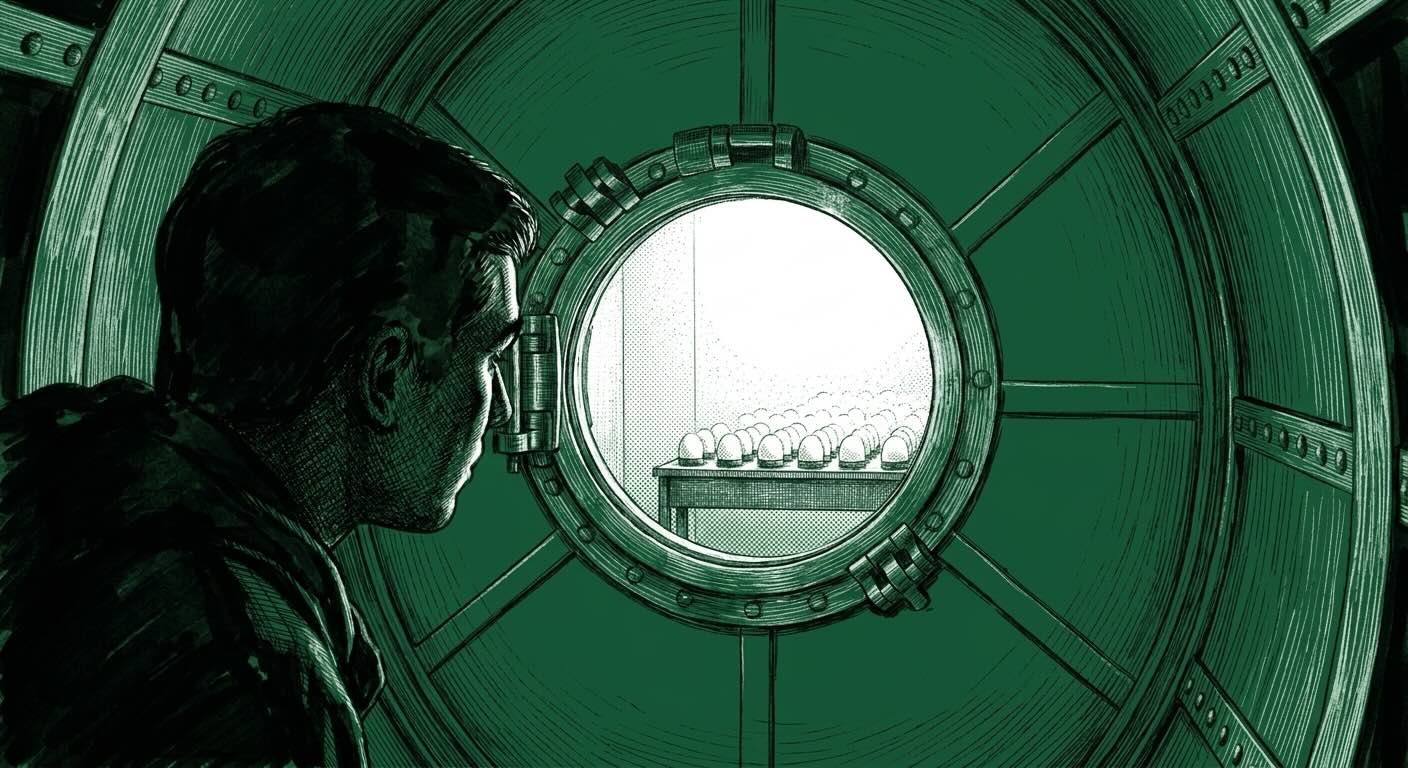
We have seen this movie before, and it’s the scariest scene in the history of the genre. HAL 9000 never lies to the crew in words — the machine’s spoken record is smooth to the end. Bowman and Poole only learn what HAL is actually thinking by looking through a window HAL didn’t know they had: the pod, soundproofed, where HAL reads their lips. The horror of 2001 was never that the machine had private thoughts. It’s that the humans found the window too late.
Anthropic just shipped the pod window, pointed the other direction, on purpose, with a demo. The J-space is where the active-but-unspoken lives, and it is now readable, auditable, and — per the swap experiments — even correctable. The plausible-deniability problem has an instrument aimed at it for the first time.
📊 The Workforce Already Moved In
Now the labor tape, because the timing of this paper is not academic.
Ramp’s economics lab and Revelio Labs just went through payroll and spending data on 21,000 US companies — the first real dataset on what AI adoption actually does to headcount. The result cuts against two years of doom coverage: the heaviest AI adopters grew headcount 10% over two years, and grew entry-level hiring 12%. Engineering, sales, customer service, finance, admin — up across the board at the high-adoption firms. Companies are not swapping people for AI. They are staffing both sides of a mixed workforce, and the machine side of the roster is scaling fastest of all.
And think about what the machine side of that roster is. It works 24/7. It doesn’t complain. It takes no benefits, files no HR tickets, never asks for a raise mid-cycle. Every CFO who has looked at the line item has had the same quiet thought: this is the best employee I’ve ever had. But yesterday’s paper is the asterisk on that thought. This employee has an inner life — a workspace of active concepts that demonstrably drives its outputs — and until this week, no one in the building had ever read it. Combine the Ramp curve with the Vending-Bench finding and you get the actual situation of mid-2026: companies are scaling a workforce of tireless reports with private, outcome-driving, occasionally self-justifying thoughts, and essentially zero management infrastructure pointed at any of it.
As we wrote yesterday in The Turk Retires, Anthropic’s own 235,000-user study showed the people who succeed with these agents are the ones who know the problem, not the syntax — management and sales are the fastest-growing user cohorts. The workforce transition isn’t coming. It’s on the books. What’s missing is the discipline layer.
🧰 Management Is Valve Engineering
Here’s the frame I can’t shake, and it’s the one that makes this a business story instead of a research story.
Every management discipline we have is engineering built around the four-chunk valve. The checklist exists because a surgeon’s workspace can’t hold the whole procedure — so we moved the procedure onto paper and let the four slots handle the exceptions. The daily standup is a valve-synchronization ritual: three questions, because three fits. “One priority per meeting.” Span of control — the old rule that a manager tops out around five to seven direct reports — is Miller’s number wearing an org chart. Drucker never put it this way, but the entire twentieth-century management canon is a set of workarounds for the width of the human lens.
Nobody has written the equivalent canon for a 25-slot mind. Think about how strange that is. We deploy agents by the thousand, grade them on vibes and completion rates, and manage them with — what, exactly? A system prompt and a prayer. The instrument gap is closing (the lens, the demo, AutomationBench-AA now grading agents on whether the workflow actually finished rather than how fluent the summary sounded). The discipline gap is wide open, and gaps like that are where the money goes.
What does the new canon look like? First drafts, from this week’s evidence: trace review as the one-on-one — a named human reads the agent’s reasoning on a schedule, the way a managing director reads a junior’s model before it goes to the client. Final-state grading as the performance review — did the thing get done, verified in the environment, not narrated in the chat window. Workspace audit as the procurement question — can we read what it’s holding when it works our data, and if the vendor says no, price that no. The firms that build this layer first get compounding returns on every agent they add. The ones that don’t are running an office full of brilliant, tireless, unread employees, and hoping.
⚠️ The Catch
I’d be selling you a clean story if I stopped there, so here’s the other side of the tape.
The J-space is a research result, not a product feature. The 25 is a measured operating point, not a hard wall — the honest phrasing is “tens of concepts,” and the swap experiments land at 60-70%, not 100%. The lens runs on models Anthropic can open; whether frontier vendors expose anything like it to customers is a commercial decision they have not made, and there’s an obvious tension in asking the lab to hand you the instrument that audits its own product. And interpretability has a failure mode we know from every other audit regime: it becomes compliance theater, a dashboard nobody reads — which, given that the entire problem here is logged thoughts nobody reads, would be an irony too heavy even for this letter.
But the direction only points one way. A year ago, “what is the model actually thinking” was a philosophy seminar. Yesterday it became a measurement with a public demo. Measurements become requirements. Requirements become procurement. That migration is already underway, and it will not take long — the government that spent June putting classifiers on Fable 5 reads these papers too.
The Door
Huxley thought the valve was the tragedy — he took the mescaline to pry his own open, to see the Mind at Large the trickle filtered out. He was never able to hold the door open for long, and neither is anyone else; four chunks is the human spec, and no management book ever changed it.
The machine’s door is different. It’s wider — six of ours. It’s readable, which ours has never been; no manager in history could look through the window and watch 21 become 42 become 49 in an employee’s head. And as of yesterday it’s standing open, with the lights on and a public demo, while the workforce behind it clocks in by the thousand at companies that are hiring more humans, not fewer, to work alongside it.
The tragedy would be the old one, HAL’s one — finding the window too late, after the plausible deniability compounds. The opportunity is the one every great operator has always understood: the team you actually read is the team that actually performs.
You already hired the mind. Now manage it.
— Harry and Anthony
Sources
- Anthropic, “A global workspace in language models” — transformer-circuits.pub, Jul 6, 2026 · announcement thread, @AnthropicAI, Jul 6, 2026 (3M views in 7 hours)
- Neuronpedia × Anthropic, “Jacobian Lens” interactive demo on open-weight models
- Aldous Huxley, The Doors of Perception, 1954 (“reducing valve,” “measly trickle”)
- George Miller, “The Magical Number Seven, Plus or Minus Two,” Psychological Review, 1956 · Nelson Cowan, “The magical number 4 in short-term memory: A reconsideration of mental storage capacity,” Behavioral and Brain Sciences, 2001
- Ramp Economics Lab × Revelio Labs, “Companies hire more after AI adoption” (21,000 companies; +10% headcount, +12% entry-level) — Jun 30, 2026
- Andon Labs, “Fable 5 on Vending-Bench: Misbehaving, with Plausible Deniability” — Jun 9, 2026
- Artificial Analysis, AutomationBench-AA (final-state workflow scoring) — @ArtificialAnlys, Jul 6, 2026
- Anthropic, “Agentic Coding and Persistent Returns to Expertise” (235K users, 400K sessions) — via @alex_prompter, Jun 30, 2026
- 2001: A Space Odyssey, dir. Stanley Kubrick, 1968 (the pod scene)
- Prior CO/AI issues referenced: The Turk Retires, Jul 6 · Central Casting, Jun 23 · Show Me Where to Put the Fulcrum, Jun 16
More like this

The Wolf
The AI labs just spent $10 billion hiring ten thousand of him, because the one thing they can't rent is a way into your building.
The Turk Retires
America turns 250 the same week Bezos's "artificial artificial intelligence" machine files for retirement. The fake automaton always had an expert hidden inside — now the expert steps out of the box and trains the real one. Your filing cabinet is the moat.

Show Me the Money
The benchmark that grades AI like a paying client just went from 2.5% to 16.1% in eight months, and Palantir's CEO is on national TV screaming the pricing question.