The Livestream That Made 543,000 People Realize We’re Cooked

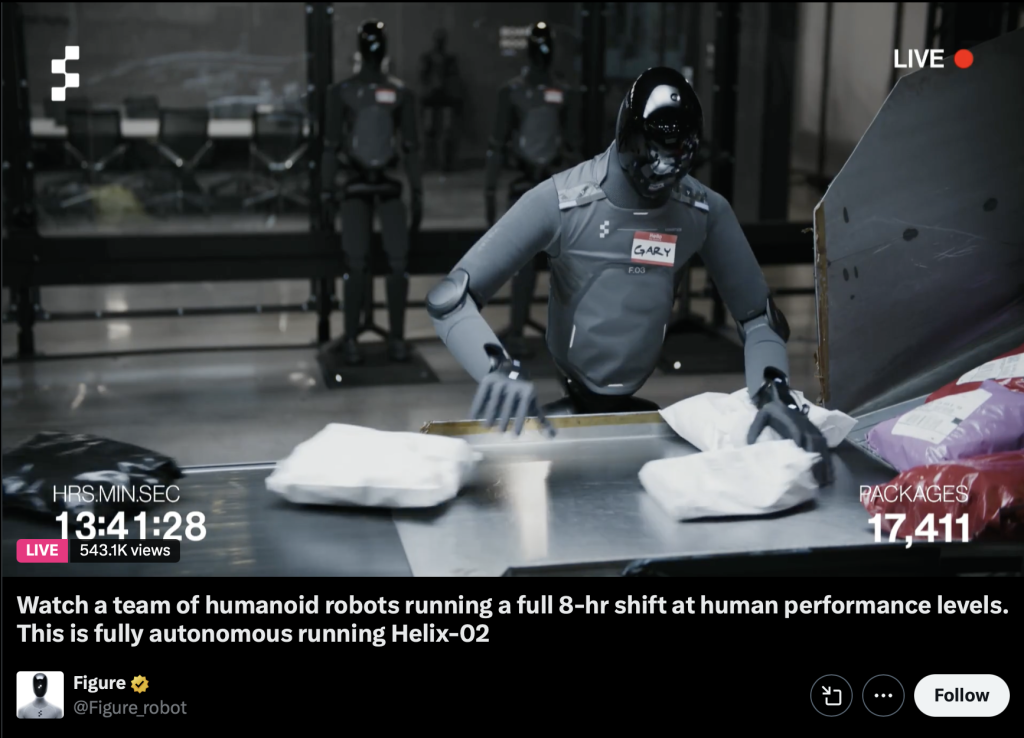
I was one of the 543,000 people that watched robots work a warehouse shift on a live stream and nobody was celebrating.
That’s the thing nobody talks about when they imagine the future. They talk about the economics. The efficiency gains. The disruption. What they don’t talk about is how eerie it would feel to actually watch it happen in real time.
On May 8th, 2025, Figure AI livestreamed humanoid robots—Helix-02 units—doing a full 8-hour shift in a warehouse. Fully autonomous. No human intervention. No puppeteers. No prerecorded segments. A live production run being broadcast with a timestamp and viewer count in the corner like you’re watching someone stream on Twitch, except instead of someone playing a video game it’s something that moves like a person but isn’t, methodically handling packages in a warehouse while 543,000 concurrent viewers watched.
And the feeling was eerie. Genuinely eerie. Like watching a space alien walk across your street.
The Uncanny Valley Made Real
There’s a concept from robotics called the uncanny valley. As robots become more human-like, we find them more likeable—until they get almost human but not quite. Then they become deeply disturbing. It’s not that they’re obviously artificial. It’s that they’re almost-but-not-quite human. The slight wrongness. The efficiency without purpose. The motion without intent.
Figure’s Helix-02 units live in that valley. They move with eerie efficiency. They handle packages with precision. They work continuously without fatigue or complaint. And they do it while looking almost like a person—grey suit, humanoid torso and limbs. Close enough to trigger your pattern-recognition system. Wrong enough to trigger your uncanny valley alarm.
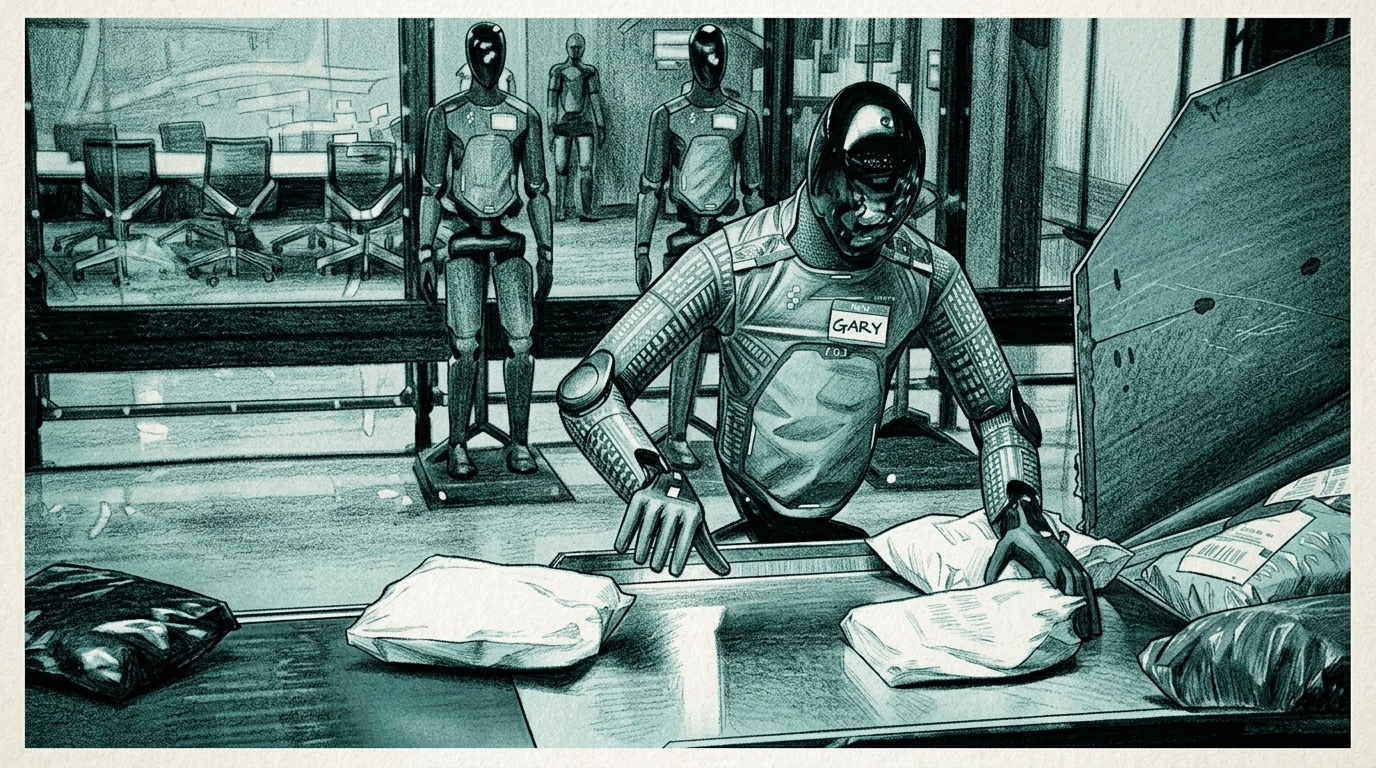
And then there’s the name badge. “GARY.”
A name. That detail pushes it from impressive-robot into deeply-wrong territory. Not just because a robot is doing the job. But because it’s been given an identity. An employee number. A place in the org chart. A name that makes it fit into the human workplace structure, even though it’s not human. That’s the cringe moment. That’s what makes you recoil slightly while watching.
That discomfort is not a bug. It’s a signal.
The Sci-Fi We Grew Up With
We read the books. We watched the movies. Terminator. Blade Runner. The Matrix. All of them had this moment—the moment when you realize that what you thought was distant future is actually happening now, on a screen, in real time, and you can’t look away.
Most of us, I think, expected that moment to feel more dramatic. We imagined it would be scary, or thrilling, or something that would demand an immediate response. What I didn’t expect was for it to feel unsettling in a way that’s hard to articulate. Not “robots are coming to take over.” More like: “Oh. So this is what it looks like when the sci-fi becomes real. It looks like that.”
The livestream is the signal moment. Not the technology (which has been developing for years). Not the announcement (Figure has been building this). The livestream. The moment when you can open your browser and watch the future happen at 543,000 concurrent viewers.
We Knew This Was Coming
I’ve built software. I’ve watched automation replace tasks, then jobs, then entire categories of work. I know the pattern. Every wave of technology goes through the same arc: it’s impossible, then it’s a gimmick, then it’s experimental, then it’s production, then it’s everywhere.
We knew robots doing human work was coming. Economists wrote papers about it. Technologists built toward it. Policy people debated it. We had a decade of warnings.
What we didn’t do is prepare. Not because we couldn’t. Because it’s easier to keep something theoretical. To debate it. To say “maybe this, maybe that.” The livestream ends that. You can’t theoretical-ize what you’re actively watching happen.
What the Livestream Actually Shows
Figure’s Helix-02 units did exactly what a warehouse worker does: picked items, placed them in boxes, moved items from one place to another. Nothing exotic. Nothing that required superhuman capability. Just the job that millions of people do every day, now being done by something that looks almost-but-not-quite human, on a livestream, at production scale.
That’s the eerie part. Not that robots are doing something impossible. But that they’re doing something mundane. Something boring. Something that doesn’t require consciousness or intent or feeling—just motion and pattern recognition and tireless execution.
For the people watching that livestream, many of whom work in warehouses or logistics or adjacent fields, the message was clear: this is what’s coming for your job. Not in some distant future. Now. Being demonstrated. On a livestream. With a timestamp.
The Unspoken Part of the Livestream
What nobody said out loud—because it would be impolite, and we’re still pretending this is something we can debate rationally—is: we know we are cooked.
Not “we might be cooked.” Not “we should prepare for cooked.” We know. We’re watching it happen. The logistics companies are watching it happen. The warehouse workers are watching it happen. Everyone understands what they’re looking at.
The question isn’t whether humanoid robots will replace warehouse workers. The livestream answered that. The question is: what happens to the people who are about to stop being economically necessary?
That’s not a technology problem. That’s a society problem. And we don’t have a plan for it. We have think pieces. We have debates. We have people who think it’s fine and people who think it’s catastrophic and everyone pretending the livestream isn’t happening.
But 543,000 people watched it happen. And they felt what I felt watching it.
That eerie recognition of the moment when theory becomes real.
The Sci-Fi We Actually Got
I grew up reading and watching the sci-fi we thought was coming: dramatic moments, clear inflection points, moments where you’d know things had changed. Skynet goes online. The Matrix reveals itself. The aliens land.
The actual future is less dramatic. It’s a livestream. It’s 543,000 concurrent viewers. It’s a robot in a grey suit with a name badge that says “GARY”—complete with the small detail that makes it horrifying: it’s been given a name. An identity. A place on the roster. It’s the uncanny valley made production-ready. It’s eerie and ordinary at the same time.
The robots aren’t going to announce themselves as your replacements. They’re just going to keep working. Shift after shift. In livestreams you can watch whenever you want. With names. With name badges. Fitting smoothly into the human workplace until one day you realize the thing that kept you employed doesn’t exist anymore because the robot is better at it and doesn’t require healthcare or a 401k or, apparently, any sense of what it’s like to be tired.
That’s the sci-fi we actually got.
And we’re watching it happen in real time.
What Comes Next
In five years, Amazon warehouses will look like scenes from Star Wars. Not the dramatic parts. The background scenes. Rows of workers in the wider shots that nobody was looking at—that was the future. Humanoid robots moving packages. Loading trucks. Scanning inventory. The kind of work that doesn’t require being human. Just repetition and precision.
The airports will follow. Then the factories. Then the logistics hubs. The Helix-02 units will keep working. Better versions will ship. Faster, stronger, cheaper to operate than the previous generation. The livestreams will keep happening. People will watch. Fewer and fewer of those viewers will be warehouse workers, because there won’t be many of those jobs left.
And here’s the part nobody’s talking about out loud: millions of people who didn’t get a better job are about to stop being economically necessary. They’re not going to voluntarily leave. They’re going to keep existing. They’ll be looking for work that doesn’t exist, or work that the robot is already better at. Some will find something. Some will go on welfare. Some will get desperate enough that the social contract breaks and they’ll take what they need instead of waiting for the system to provide it.
That’s not a technology problem. That’s not even an economics problem yet, though it will become one. It’s a society problem. And we’re collectively pretending the livestream isn’t happening while we wait for someone else to figure out the answer.
But 543,000 people watched it happen. And they know what’s coming.
That eerie recognition of the moment when theory becomes real, and you realize what real actually looks like when it arrives at your street.
More like this
Eiso Kant: The AI Founder Who Lost a $2 Billion Round, Then Shipped Anyway
The setback nobody’s talking about, including him. In October 2025, Poolside announced Project Horizon: a 2-gigawatt AI data...

The Real AI Race Isn’t Model vs. Model Anymore. Here’s Where Poolside Actually Fits.
The closed frontier is down to two names, and one of them just changed Start with the giants,...

The Week Kimi K3 Broke the Internet: Inside Moonshot AI’s Biggest Launch Yet
On July 17, Chinese AI lab Moonshot AI released Kimi K3, and by every measure available, the internet...