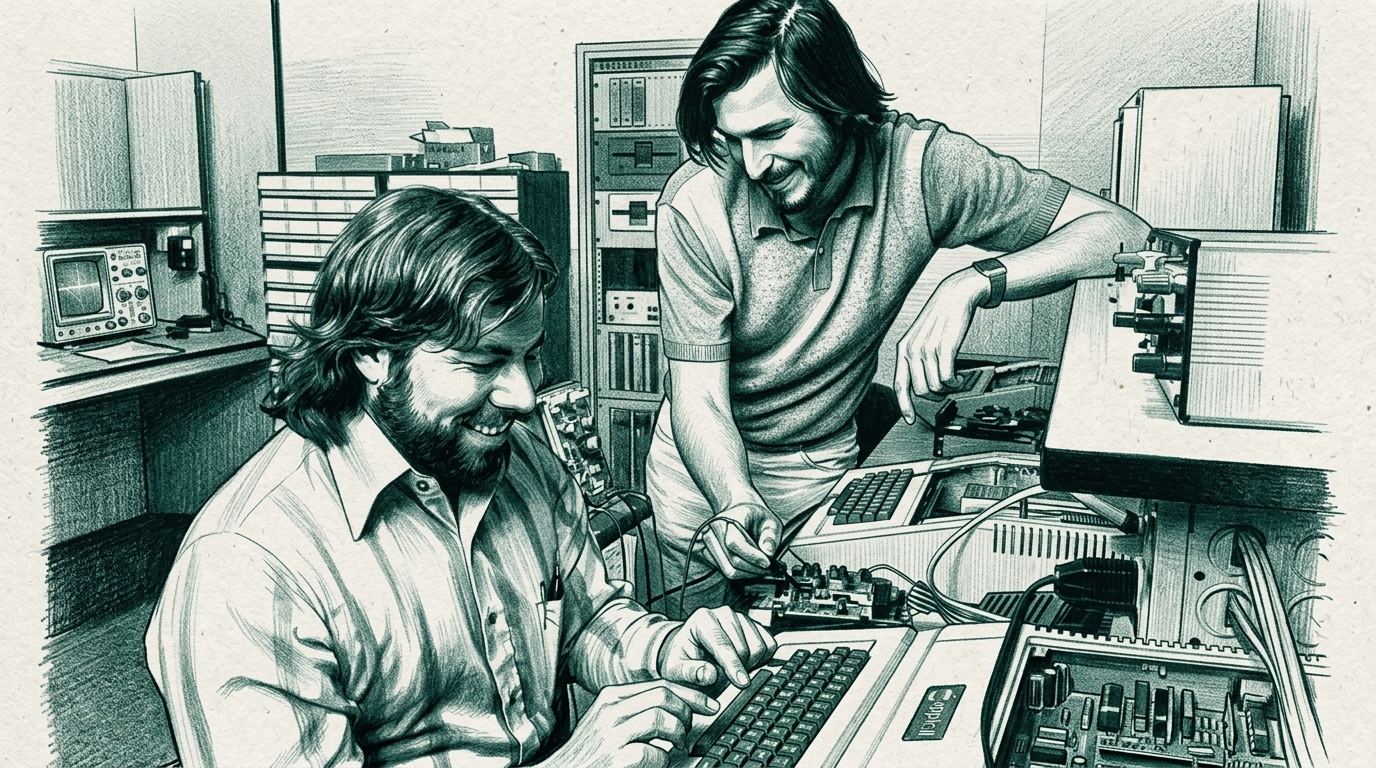

I’ve been an Apple user since the Apple II. I remember the rainbow cable. I was in the line for the early all-in-one Macintosh. I’ve built software for the Mac and iOS for decades. I own a Vision Pro. I’m not a casual observer.
Which is why I can tell you what I think is actually happening at Apple right now has almost nothing to do with what the tech press thinks.
Tim Cook didn’t step down. He stepped away from an argument he lost.
On the surface, the succession reads clean: Cook becomes executive chairman. John Ternus, a hardware engineer who spent 25 years running Apple’s silicon, becomes CEO. Johny Srouji, the architect of Apple’s chip design, gets elevated to Chief Hardware Officer. The two people who control silicon now control the entire company.
Read the org chart. That’s the story. Not continuity. Not a smooth transition. A strategic pivot.
The Race Apple Decided Not to Run
The AI industry is locked in a spending war. Google will burn $90 billion this year on AI infrastructure. Meta committed $65 billion (at the time of writing we don’t know what they have for consumers to use). Microsoft, Amazon, and Google are collectively spending $300 billion. They’re racing toward bigger models, faster inference, frontier capabilities.
Apple? $12.7 billion in total capital expenditure for the entire year.
The conventional narrative is that Apple is losing. Siri is still a punchline. The promised AI features got delayed again. Analysts called the strategy a “disaster”—Apple is one to two years behind.
But that reading assumes Apple is playing the same game everyone else is. They’re not.
Apple’s board looked at the frontier model race and did something nobody else is doing out loud: they admitted they can’t win it on those terms. Not because Apple is incapable. Because the organizational structure that built the iPhone—functional departments arguing toward integration across every layer—is precisely the wrong structure for winning a capability race where the winner is whoever ships the next breakthrough model first.
Frontier labs ship a new model every quarter. Their org charts let one person decide. Under Tim Cook, every major decision got argued across functions horizontally. That’s how you ship a polished product. It’s also how you fall a year behind while the labs keep iterating.
So the board made a choice: don’t try to compete on the terms that favor the labs. Change the game.
That moment is when having control of your hardware, your silicon, your distribution, and your customer relationship becomes worth more than having the fanciest model.
What Changed the Game: The Economics Flipping
Here’s what most people get wrong about AI: they think the war is about capability. The war is about cost structure.
As Fortune noted recently, “The foundation model market is beginning to exhibit classic signs of commoditisation. Prices are collapsing: Anthropic recently cut prices by 67%, Google has slashed rates by 70%-80%, and OpenAI has repeatedly reduced costs on successive models. This is textbook commodity market behaviour.”
When a market commoditizes, the winner isn’t the company with the best component. It’s the company that controls the integration layer and owns the customer relationship.
Apple has 2.4 billion active devices. The most valuable distribution channel in consumer technology. And it’s deploying a deliberate strategy: don’t build frontier models. Source them from whoever is best at any given moment—OpenAI one year, Google the next—wrap them in your architecture, and own the experience.
This is what Apple has done. Partnered with OpenAI. Then switched to Google’s Gemini. The company is curating the best available engine, not building the engine itself.
Own the integration layer. Outsource the commodity.
Ben Thompson, who has been analyzing Apple’s moves closely, made this explicit when examining the M3 Ultra chip: “What makes Apple’s chip architecture unique is that RAM is shared by the CPU and GPU…every part of the chip has full access to all of the memory all of the time. What that means in practical terms is that Apple just shipped the best consumer-grade AI computer ever.”
You can run state-of-the-art reasoning models on your Mac. On-device. No cloud. No subscription. This is not theoretical—I can do it on my M4 & M5 MacBook right now.
The Economics Are Flipping
On-device inference has fixed costs. You paid for the chip when you bought the device. After that, asking the model a thousand questions costs the same as asking it one. Just electricity.
Cloud inference has variable costs. Every query gets priced. Someone pays every time.
Right now that someone is the labs, subsidized by investors. Eventually that cost gets passed to users. The meter starts running.
Apple’s silicon is the escape hatch from that meter.
On-device AI costs are decreasing at 25% year-over-year. Cloud compute is growing at 16%. The math is flipping. This is the inflection point nobody in the hype cycle is paying attention to.
The Market That’s Already Forming
While the frontier labs race toward bigger datacenters, a specific population is solving an urgent problem: law firms, medical practices, accounting firms, tax advisors, therapists, financial advisors. Anyone whose work carries a legal or regulatory bar on data confidentiality.
These firms are watching competitors pull ahead using cloud AI and facing enormous pressure. But they can’t use it. Running client work through a public cloud AI service is often a malpractice problem, a regulatory problem, or a client trust catastrophe. Even if it’s technically compliant, telling your client “your confidential information was processed by a cloud model two countries away” is a losing conversation.
So these firms are doing something practical: they’re buying Mac Minis. Literally a handful of M-series Mac Minis clustered together can run sophisticated generative models locally. For a few thousand dollars in hardware sitting in a closet on the firm’s network. The data never leaves the building. The privilege holds. The compliance story works.
This is happening right now. These firms are improvising because Apple hasn’t built the product yet. There’s no rackable enterprise form factor for Apple silicon. No clustering software. No HIPAA business associate agreements. No admin tools IT teams expect. None of the infrastructure a law firm would want from an enterprise vendor.
That gap is measured in trillions. The US professional services economy alone is trillions. A meaningful slice—law, medicine, finance, therapy, accounting—has a structural need for AI that never goes to the cloud.
They know it. They’re trying to buy a solution. Nobody’s selling one cleanly.
Why This Pattern Matters
This is not Apple’s first time here.
MP3 players existed since 1998. Three years before the iPod. Samsung and Sony had smartwatches years before the Apple Watch. Bragi shipped true wireless earbuds two years before AirPods. BlackBerry, Palm, Nokia dominated smartphones before the iPhone redefined everything.
In each case, Apple let others absorb the pioneer costs. Watched what worked. Entered late. Integrated brilliantly. Won.
The pattern is consistent: Apple views first-mover advantage as overrated and timing discipline as underrated.
Apply that to AI. The frontier labs are burning through pioneer costs right now. Proving the market exists. Proving what works. The Valley is obsessed with the race they’re winning at the component layer.
Apple is watching. Integrating. Preparing to own the layer where the actual customer relationship lives.
What This Actually Means
When you’ve been apart of the Apple ecosystem as long as I have—through the rainbow cable era, the Macintosh revolution, the iPhone, the iPad, and now to a point where I can run sophisticated AI models on devices I own and control—you see a pattern emerge.
Apple doesn’t win by being first. Apple wins by being integrated. By controlling the layer that matters most. By understanding that in any wave of technology, there’s a moment when the frontier moves from “what’s possible” to “what’s profitable at scale.”
That moment is when having control of your hardware, your silicon, your distribution, and your customer relationship becomes worth more than having the fanciest model.
The board just decided that moment is now.
Two silicon engineers at the top. A CEO who spent 25 years building Apple’s chips. A Chief Hardware Officer who architected them. The message is unmistakable: this is a hardware company making a hardware bet.
Not because cloud AI is going away. But because the companies that thrive won’t be the ones that built the biggest models. They’ll be the ones that control the layer where those models actually become useful—the device, the integration, the customer relationship.
Apple bet on that layer forty years ago with the Apple II. It worked. It worked with the Macintosh. With the iPod, the iPhone, the iPad. With every major wave, the same pattern: don’t race to build the underlying technology. Build the platform that makes that technology matter.
The AI race is about to flip from frontier labs competing on capability to companies competing on integration and cost structure. Apple is restructuring around that race.
One year from now, when the frontier model market looks even more commoditized and the on-device AI stack keeps improving, people will look back at this CEO transition and finally understand what the board was actually saying.
Change the game.
Three Questions
Do you work in a field where data confidentiality is a core constraint? Are you improvising with local solutions right now, or waiting for someone to sell you a real product?
Are you building a product that only makes economic sense when inference is free? Because that thesis just got viable hardware underneath it.
Which race do you actually want to win? Because the one everyone’s playing might not be the one you’re set up to win.
Anthony Batt
Subscribe to our Newsletter Signal/Noise — We separate the pattern from the noise
Listen to our Podcast: Future-Proof Pod
More like this
Eiso Kant: The AI Founder Who Lost a $2 Billion Round, Then Shipped Anyway
The setback nobody’s talking about, including him. In October 2025, Poolside announced Project Horizon: a 2-gigawatt AI data...

The Real AI Race Isn’t Model vs. Model Anymore. Here’s Where Poolside Actually Fits.
The closed frontier is down to two names, and one of them just changed Start with the giants,...

The Week Kimi K3 Broke the Internet: Inside Moonshot AI’s Biggest Launch Yet
On July 17, Chinese AI lab Moonshot AI released Kimi K3, and by every measure available, the internet...