
Teaching Gemini to Speak YouTube: Adapting LLMs for Video Recommendations to 2B+DAU
Google's AI transformation is reshaping YouTube
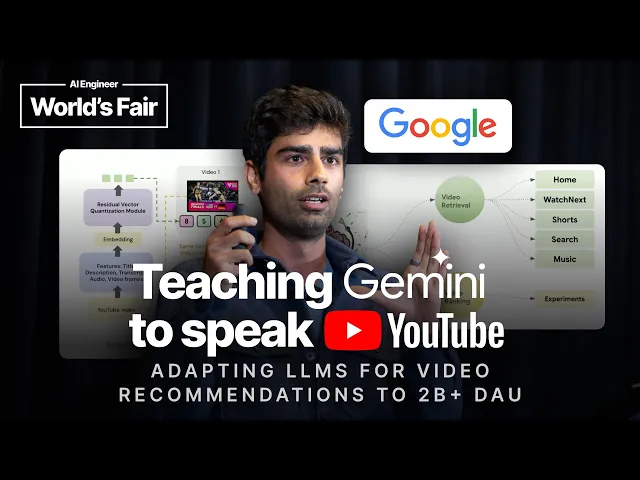
Google's embrace of AI is fundamentally changing how its flagship products operate, with YouTube—the world's second most visited website—serving as a critical testing ground for its Gemini models. At a recent AI conference, Google's Devansh Tandon unveiled how the company has adapted large language models to power YouTube's recommendation systems, potentially transforming how over two billion daily active users discover content on the platform.
The transformation represents one of the largest-scale deployments of AI in a consumer product, with Google carefully balancing innovation against the risks of disrupting a platform that accounts for significant revenue and user engagement. What makes this particularly noteworthy is how Google has managed to adapt generalist LLMs for the specialized domain of video recommendations at unprecedented scale.
Key technical innovations behind the scenes
- Google created a specialized instruction tuning dataset combining both human annotations and synthetic data generation to teach Gemini models to understand video content and user preferences
- Engineers developed novel techniques to compress user history into tokens that LLMs can process while preserving chronology and context across viewing sessions
- The team implemented a hybrid architecture where Gemini models work alongside traditional recommendation systems, allowing for gradual integration while maintaining performance
The most impressive aspect of Google's approach isn't just the technical implementation but their systematic methodology for adapting general-purpose AI models to specialized tasks without compromising either quality or efficiency. Unlike many AI implementations that remain theoretical or limited to research environments, Google's YouTube deployment demonstrates how large language models can be practically integrated into existing products with billions of users.
"What we're seeing is an evolution in how AI models can be adapted from general capabilities to domain-specific applications," explains Dr. Ellen Markman, professor of cognitive science at Stanford University. "Google's approach of using both human expertise and synthetic data generation to teach models about video content preferences represents a significant advancement in applied AI."
This matters tremendously because it foreshadows how other major platforms might integrate foundation models into their core functionality. Rather than building specialized AI systems from scratch, companies can potentially adapt existing foundation models through careful instruction tuning and system design. The implications extend far beyond YouTube to virtually any platform relying on content discovery and personalization.
The business implications extend beyond recommendations
What Google didn't explicitly address in the presentation are the broader business implications of this approach. Beyond improving
Recent Videos
How To Earn MONEY With Images (No Bullsh*t)
Smart earnings from your image collection In today's digital economy, passive income streams have become increasingly accessible to creators with various skill sets. A recent YouTube video cuts through the hype to explore legitimate ways photographers, designers, and even casual smartphone users can monetize their image collections. The strategies outlined don't rely on unrealistic promises or complicated schemes—instead, they focus on established marketplaces with proven revenue potential for image creators. Key Points Stock photography platforms like Shutterstock, Adobe Stock, and Getty Images remain viable income sources when you understand their specific requirements and optimize your submissions accordingly. Specialized marketplaces focusing...
Oct 3, 2025New SHAPE SHIFTING AI Robot Is Freaking People Out
Liquid robots will change everything In the quiet labs of Carnegie Mellon University, scientists have created something that feels plucked from science fiction—a magnetic slime robot that can transform between liquid and solid states, slipping through tight spaces before reassembling on the other side. This technology, showcased in a recent YouTube video, represents a significant leap beyond traditional robotics into a realm where machines mimic not just animal movements, but their fundamental physical properties. While the internet might be buzzing with dystopian concerns about "shape-shifting terminators," the reality offers far more promising applications that could revolutionize medicine, rescue operations, and...
Oct 3, 2025How To Do Homeless AI Tiktok Trend (Tiktok Homeless AI Tutorial)
AI homeless trend raises ethical concerns In an era where social media trends evolve faster than we can comprehend them, TikTok's "homeless AI" trend has sparked both creative engagement and serious ethical questions. The trend, which involves using AI to transform ordinary photos into images depicting homelessness, has rapidly gained traction across the platform, with creators eagerly jumping on board to showcase their digital transformations. While the technical process is relatively straightforward, the implications of digitally "becoming homeless" for entertainment deserve careful consideration. The video tutorial provides a step-by-step guide on creating these AI-generated images, explaining how users can transform...