
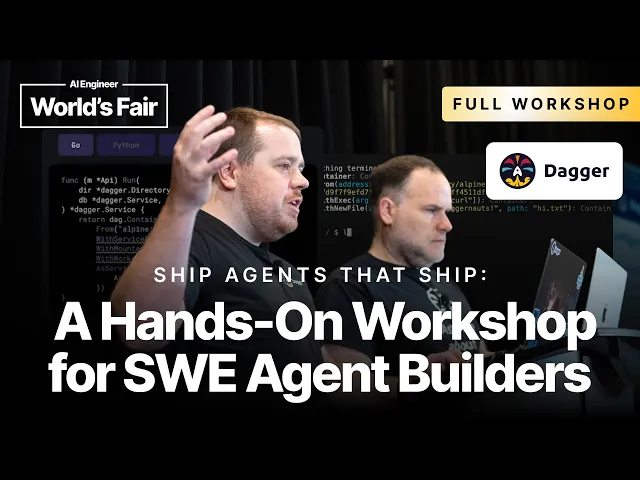
Ship Agents that Ship: A Hands-On Workshop – Kyle Penfound, Jeremy Adams, Dagger
Ship or sink: embrace agent architecture today
In the evolving landscape of software development, the shift toward agent-based architecture is becoming increasingly pronounced. At a recent workshop led by Kyle Penfound and Jeremy Adams from Dagger, developers were given a hands-on introduction to building software agents that actually deliver value—not just conceptual frameworks that never see production. The session illuminated how these autonomous software entities can revolutionize development workflows and enhance productivity in ways traditional approaches simply cannot match.
Key Points
-
Agent architecture fundamentally transforms development by creating autonomous software entities that can perceive, reason about, and act within their environment without constant human intervention
-
The Dagger platform provides a structured approach to agent development through its SDKs and Engine, enabling developers to rapidly create and deploy functional agents with minimal boilerplate
-
Real-world agent implementation requires thoughtful consideration of prompt engineering, context management, and understanding the limitations of underlying large language models (LLMs)
Beyond the buzzword: what makes agent architecture transformative
The workshop's most compelling insight wasn't about futuristic AI capabilities, but rather the pragmatic approach to creating usable agents today. While many discussions about AI agents remain theoretical, Penfound and Adams demonstrated concrete implementation patterns that allow developers to ship functional agents now, rather than waiting for perfect solutions.
This matters tremendously as businesses increasingly face pressure to automate processes while addressing developer shortages. The agent architecture approach doesn't just represent another development methodology—it represents a fundamental shift in how we conceptualize software interaction with systems. By creating autonomous entities that can reason about their environment and take appropriate actions, companies can dramatically reduce manual intervention in complex workflows.
The hidden challenges of agent development
What the workshop touched on, but deserves deeper exploration, is the significant challenge of context management in agent development. Agents require carefully curated information about their environment to make appropriate decisions. Too little context, and they make naive choices; too much, and they exceed token limits or struggle with relevance.
Consider a DevOps agent tasked with troubleshooting production incidents. Without proper context boundaries, such an agent might attempt to analyze terabytes of logs or, conversely, miss critical information from related systems. Companies like Netflix have experimented with context-aware agents that gradually build mental models of their production environments, starting with limited scope an
Recent Videos
Andrej Karpathy on the Decade of Agents, the Limits of RL, and Why Education Is His Next Mission
A summary of key takeaways from Andrej Karpathy's conversation with Dwarkesh Patel In a wide-ranging conversation with Dwarkesh Patel, Andrej Karpathy — former head of AI at Tesla, founding member of OpenAI, and creator of some of the most popular AI educational content on the internet — shared his views on where AI is headed, what's still broken, and why he's now pouring his energy into education. Here are the key takeaways. "It's the Decade of Agents, Not the Year of Agents" Karpathy's now-famous quote is a direct pushback on industry hype. Early agents like Claude Code and Codex are...
Oct 6, 2025How To Earn MONEY With Images (No Bullsh*t)
Smart earnings from your image collection In today's digital economy, passive income streams have become increasingly accessible to creators with various skill sets. A recent YouTube video cuts through the hype to explore legitimate ways photographers, designers, and even casual smartphone users can monetize their image collections. The strategies outlined don't rely on unrealistic promises or complicated schemes—instead, they focus on established marketplaces with proven revenue potential for image creators. Key Points Stock photography platforms like Shutterstock, Adobe Stock, and Getty Images remain viable income sources when you understand their specific requirements and optimize your submissions accordingly. Specialized marketplaces focusing...
Oct 3, 2025New SHAPE SHIFTING AI Robot Is Freaking People Out
Liquid robots will change everything In the quiet labs of Carnegie Mellon University, scientists have created something that feels plucked from science fiction—a magnetic slime robot that can transform between liquid and solid states, slipping through tight spaces before reassembling on the other side. This technology, showcased in a recent YouTube video, represents a significant leap beyond traditional robotics into a realm where machines mimic not just animal movements, but their fundamental physical properties. While the internet might be buzzing with dystopian concerns about "shape-shifting terminators," the reality offers far more promising applications that could revolutionize medicine, rescue operations, and...