The future of computing: Jony Ive and Sam Altman’s revolutionary partnership
In a groundbreaking announcement that could reshape how we interact with technology, former Apple design chief Jony Ive and OpenAI CEO Sam Altman have revealed their ambitious collaboration to create an entirely new category of AI-powered devices. The partnership, which merges Ive’s design firm LoveFrom with OpenAI, represents what may be the most significant reimagining of personal computing since the smartphone.
Beyond Legacy Computing
The core premise driving this collaboration is deceptively simple yet profound: our current computing tools are fundamentally inadequate for the AI age. As Altman illustrates, accessing today’s “magic intelligence in the cloud” requires an absurdly cumbersome process—opening laptops, launching browsers, typing queries, and waiting for responses. This friction between humans and AI represents a massive opportunity for reinvention.
“We have the opportunity here to kind of completely reimagine what it means to use a computer,” Altman declares. The products we use to connect with transformative AI technology are “decades old,” as Ive observes, making it only logical to envision something beyond these legacy systems.
The Dream Team
The partnership brings together an unprecedented collection of talent:
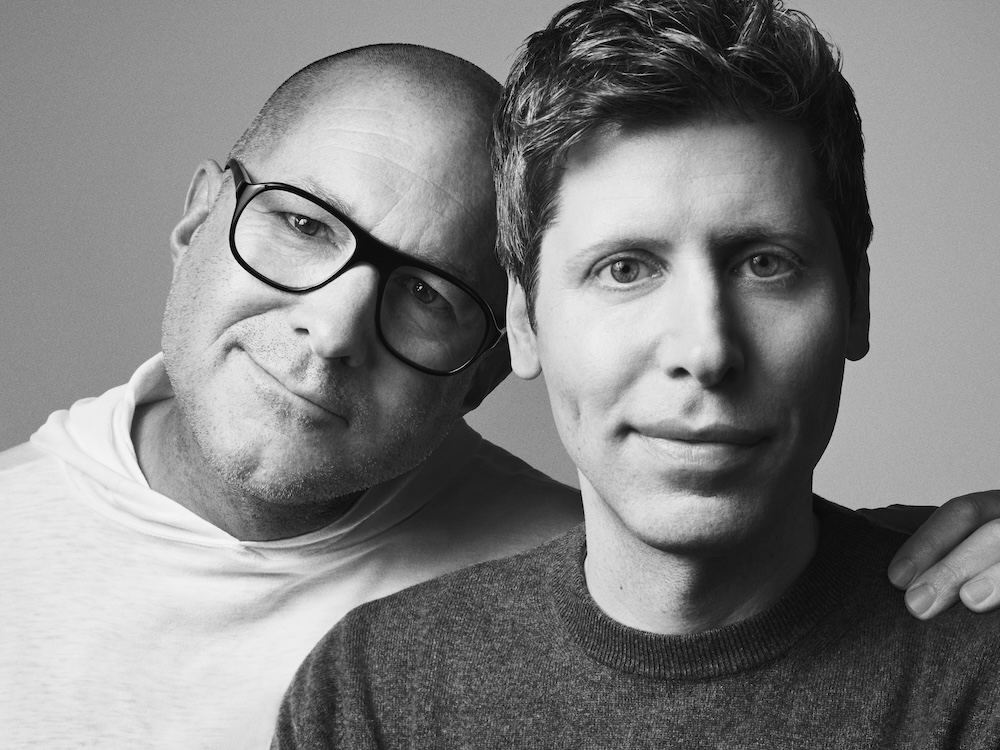
- Jony Ive’s LoveFrom: Described by Altman as “the densest collection of talent that I’ve ever heard of in one place,” this design firm represents the creative force behind some of the most influential consumer products in history
- OpenAI’s AI Leadership: The company at the forefront of the AI revolution, with models that users describe as “genius-level in every field”
- Engineering Excellence: The team includes Scott Cannon, Evans Hankey, and Tang Tan, whom Ive calls “the most extraordinary engineers”
A year ago, this group founded “io,” which is now merging with OpenAI specifically to tackle the challenge of creating AI-native devices.
The First Device: A Tantalizing Glimpse
While details remain scarce, the enthusiasm surrounding their first prototype is palpable. Ive, whose portfolio includes the iPhone and MacBook Pro—devices that literally defined how people use technology—told Altman that “this is the best work our team has ever done.” Altman, after living with a prototype, describes it as “the coolest piece of technology that the world will have ever seen.”
This isn’t mere hyperbole from a team known for measured statements and revolutionary products. It suggests a fundamental breakthrough in human-computer interaction.
What This Means for the Future
Democratizing AI Access
The partnership’s stated mission is democratization. “I want this to be democratized. I want everybody to have it,” Altman emphasizes. “I don’t want it to be the tiny percentage of the population that figures out how to use bad tools, and is really smart. I want anybody to say, hey, I have this idea. Make it happen.”
The Productivity Revolution
Early AI adopters already report being “two or three times more productive” in their fields, from scientific research to creative work. Purpose-built AI devices could amplify this effect exponentially, potentially accelerating progress in areas like medical research and innovation.
A New Computing Paradigm
Just as the iPhone replaced keypads with touchscreens and the mouse replaced command lines, these AI devices promise to replace our current indirect methods of AI interaction with something far more intuitive and powerful.
The San Francisco Factor
The announcement places significant emphasis on San Francisco as the crucible for this innovation. “You don’t get to pick and choose freedom,” one of them observes. “Either you have like you let creative freedom be expressed in all of its weirdness or you don’t.” This geographic context isn’t incidental—it’s foundational to enabling the kind of creative risk-taking required for true paradigm shifts.
An Embarrassment of Riches
“We are sitting at the beginning of what I believe will be the greatest technological revolution of our lifetimes,” the announcement declares. If their vision succeeds, we’re approaching what could be “an absolute embarrassment of riches of what people go create for collective society.”
The partnership between Ive’s unparalleled design sensibility and Altman’s AI leadership represents more than just another product launch. As Ive reflects on Altman: “The responsibility that Sam bears is— actually, is honestly beyond my comprehension… What I see you worrying about are other people, are about customers, about society, about culture. And to me, that tells me everything I want to know about someone.”
While we await concrete details about their first device, one thing is clear: the computing paradigms that have defined the last several decades may soon seem as antiquated as the command line interface feels today. The future of human-AI interaction is being reimagined from the ground up, and it’s happening in San Francisco, by the team that has consistently redefined what’s possible in personal technology.
“I am absolutely certain that we are literally on the brink of a new generation of technology that can make us our better selves,” they conclude. The revolution isn’t coming—it’s already here, being crafted in the workshops and labs of two of technology’s most visionary organizations.
More videos

Alex Karp just told CNBC the AI industry is “effing insane.”
He’s right about one thing: AI isn’t overhyped, it’s mispriced. He’s also the guy selling you the fix....

Claude Fable 5: When Capability Meets Economics
Anthropic released Cloud Fable 5 with a paradox built in: safeguards sophisticated enough to let a mythosclass model...

Run Agentic AI Entirely on Your Mac—No Cloud, No Latency, No Privacy Tradeoffs
Apple’s MLX framework is mature enough now that you can run serious agentic AI workflows locally on Silicon...