
Robots spar, play Mahjong at China’s AI conference
China's robot revolution begins with play
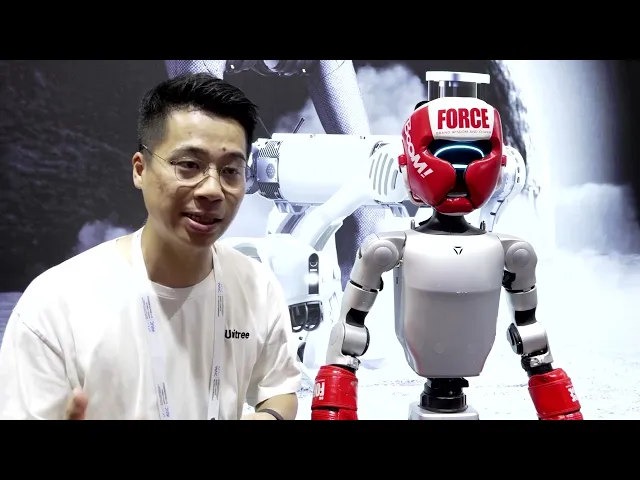
China's artificial intelligence sector is displaying its technical prowess through increasingly sophisticated robot demonstrations, as evidenced at a recent technology conference in Beijing. What began as a showcase for industrial automation has evolved into a platform for robots that can engage in human-like activities—from playing traditional games to creating art and engaging in physical sports. This shift represents China's growing ambitions in the artificial intelligence and robotics space, where capabilities are advancing from purely functional to socially interactive.
Key developments in China's robotics landscape
- Chinese robotics companies are rapidly expanding beyond industrial applications, creating machines capable of complex social interactions and recreational activities like playing mahjong and table tennis
- The development focus has shifted toward robots with improved dexterity and spatial awareness, demonstrated through activities requiring fine motor control and decision-making
- Government investment in AI infrastructure remains substantial, with China positioning itself to become a global leader in robotics technology by developing a comprehensive ecosystem of research, manufacturing, and implementation
The social dimension of technical progress
The most compelling aspect of China's robotics evolution isn't the technical specifications—it's the deliberate focus on creating machines that can participate in culturally significant activities. This approach reveals a sophisticated understanding that for robots to be truly accepted in society, they must engage with humans through shared cultural touchpoints.
This strategy aligns with broader industry trends showing that successful technology adoption depends not just on functionality, but on emotional and cultural resonance. When robots can play mahjong—a game deeply embedded in Chinese social life—they bridge the gap between cold machinery and potential companions. This represents a fundamental shift in how robotics companies are thinking about product development and market penetration.
The global context and competitive landscape
What's particularly notable about China's approach is how it differs from Western robotics development. While companies like Boston Dynamics have focused on mobility and industrial applications, and OpenAI has prioritized language models, Chinese firms appear to be taking a more integrated approach that combines physical capabilities with social functions.
The dual focus on both industrial efficiency and social integration gives Chinese companies a potential advantage in consumer markets. Consider Japan's experience with robots like Sony's Aibo—initially a novelty but ultimately limited by its inability to meaningfully participate in human activities. By contrast, robots that can engage in culturally relevant games and sports create more natural pathways for human-machine interaction
Recent Videos
How To Earn MONEY With Images (No Bullsh*t)
Smart earnings from your image collection In today's digital economy, passive income streams have become increasingly accessible to creators with various skill sets. A recent YouTube video cuts through the hype to explore legitimate ways photographers, designers, and even casual smartphone users can monetize their image collections. The strategies outlined don't rely on unrealistic promises or complicated schemes—instead, they focus on established marketplaces with proven revenue potential for image creators. Key Points Stock photography platforms like Shutterstock, Adobe Stock, and Getty Images remain viable income sources when you understand their specific requirements and optimize your submissions accordingly. Specialized marketplaces focusing...
Oct 3, 2025New SHAPE SHIFTING AI Robot Is Freaking People Out
Liquid robots will change everything In the quiet labs of Carnegie Mellon University, scientists have created something that feels plucked from science fiction—a magnetic slime robot that can transform between liquid and solid states, slipping through tight spaces before reassembling on the other side. This technology, showcased in a recent YouTube video, represents a significant leap beyond traditional robotics into a realm where machines mimic not just animal movements, but their fundamental physical properties. While the internet might be buzzing with dystopian concerns about "shape-shifting terminators," the reality offers far more promising applications that could revolutionize medicine, rescue operations, and...
Oct 3, 2025How To Do Homeless AI Tiktok Trend (Tiktok Homeless AI Tutorial)
AI homeless trend raises ethical concerns In an era where social media trends evolve faster than we can comprehend them, TikTok's "homeless AI" trend has sparked both creative engagement and serious ethical questions. The trend, which involves using AI to transform ordinary photos into images depicting homelessness, has rapidly gained traction across the platform, with creators eagerly jumping on board to showcase their digital transformations. While the technical process is relatively straightforward, the implications of digitally "becoming homeless" for entertainment deserve careful consideration. The video tutorial provides a step-by-step guide on creating these AI-generated images, explaining how users can transform...