
Real-time Experiments with an AI Co-Scientist – Stefania Druga, fmr. Google Deepmind
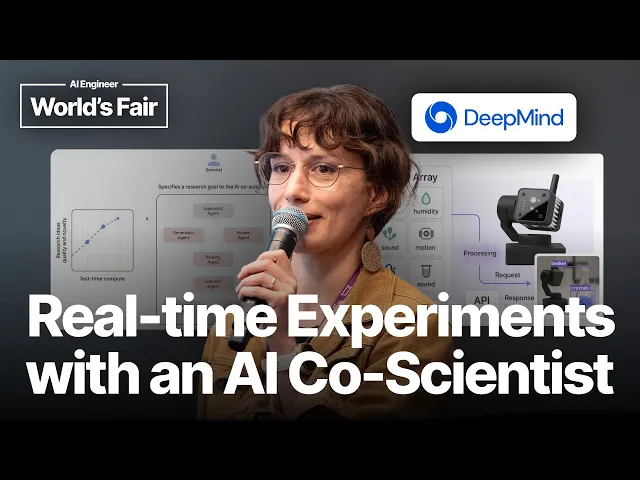
AI co-scientists transform research possibilities
The traditional scientific process is witnessing a quiet revolution. As research becomes increasingly complex and data-driven, a new kind of collaboration is emerging—one where artificial intelligence acts not merely as a tool but as a legitimate partner in discovery. Stefania Druga, formerly of Google DeepMind, has been pioneering this frontier through her work with AI co-scientists. Her experiments reveal how machine learning systems can dramatically transform how we approach complex scientific questions.
Key Points
-
AI co-scientists aren't just passive tools—they actively contribute to hypothesis generation, experimental design, and results interpretation, complementing human researchers in unprecedented ways.
-
These systems combine large language models with the ability to execute code, access databases, and operate scientific instruments, enabling them to act in real-time laboratory environments.
-
The most successful human-AI collaborations embrace a balanced approach where researchers maintain critical thinking while leveraging AI's ability to process vast information landscapes and suggest novel perspectives.
The New Scientific Partnership
The most compelling insight from Druga's work isn't the technical capability of AI in science—it's the emergence of a new collaborative model that fundamentally changes scientific practice. Unlike traditional tools that simply execute commands, AI co-scientists can engage in scientific reasoning, suggest alternative approaches, and even question human assumptions.
This matters tremendously in our current scientific landscape. Research increasingly spans disciplinary boundaries, involves massive datasets, and requires specialized knowledge across multiple domains. Individual human researchers, no matter how brilliant, face cognitive limitations in processing such complexity. AI co-scientists offer a path through this challenge by expanding the "cognitive surface area" of scientific teams.
Consider pharmaceutical research, where the traditional drug discovery process takes years and billions of dollars. AI co-scientists are already accelerating this timeline by rapidly generating and testing hypotheses about molecular structures, potentially bringing life-saving treatments to patients years earlier. The economic and human impact of such acceleration could be immeasurable.
Beyond the Video: Critical Considerations
What Druga's presentation doesn't fully address is the epistemological shift this technology represents. Throughout history, scientific knowledge has been fundamentally human-derived, with tools serving human curiosity. Now we're entering an era where some insights may emerge from AI reasoning in ways humans wouldn't naturally pursue. This creates both opportunity and legitimate questions about the nature of scientific knowledge itself.
Consider
Recent Videos
How To Earn MONEY With Images (No Bullsh*t)
Smart earnings from your image collection In today's digital economy, passive income streams have become increasingly accessible to creators with various skill sets. A recent YouTube video cuts through the hype to explore legitimate ways photographers, designers, and even casual smartphone users can monetize their image collections. The strategies outlined don't rely on unrealistic promises or complicated schemes—instead, they focus on established marketplaces with proven revenue potential for image creators. Key Points Stock photography platforms like Shutterstock, Adobe Stock, and Getty Images remain viable income sources when you understand their specific requirements and optimize your submissions accordingly. Specialized marketplaces focusing...
Oct 3, 2025New SHAPE SHIFTING AI Robot Is Freaking People Out
Liquid robots will change everything In the quiet labs of Carnegie Mellon University, scientists have created something that feels plucked from science fiction—a magnetic slime robot that can transform between liquid and solid states, slipping through tight spaces before reassembling on the other side. This technology, showcased in a recent YouTube video, represents a significant leap beyond traditional robotics into a realm where machines mimic not just animal movements, but their fundamental physical properties. While the internet might be buzzing with dystopian concerns about "shape-shifting terminators," the reality offers far more promising applications that could revolutionize medicine, rescue operations, and...
Oct 3, 2025How To Do Homeless AI Tiktok Trend (Tiktok Homeless AI Tutorial)
AI homeless trend raises ethical concerns In an era where social media trends evolve faster than we can comprehend them, TikTok's "homeless AI" trend has sparked both creative engagement and serious ethical questions. The trend, which involves using AI to transform ordinary photos into images depicting homelessness, has rapidly gained traction across the platform, with creators eagerly jumping on board to showcase their digital transformations. While the technical process is relatively straightforward, the implications of digitally "becoming homeless" for entertainment deserve careful consideration. The video tutorial provides a step-by-step guide on creating these AI-generated images, explaining how users can transform...