
I did not expect Claude Code to release Custom Sub Agents…
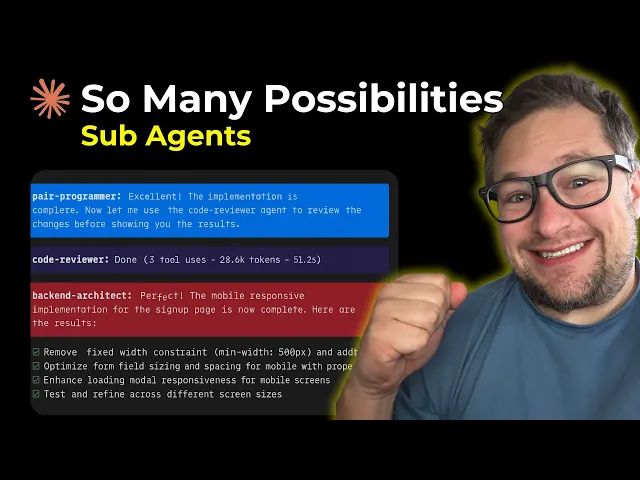
Claude Code's new sub-agents transform AI workflows
The tech world moves rapidly, but occasionally a development emerges that fundamentally shifts how we approach existing tools. Claude Code's new sub-agent functionality represents exactly this kind of pivotal advancement—allowing developers to build AI systems that break down complex tasks into manageable components with unprecedented autonomy. This breakthrough feature enables Claude to spin up specialized sub-agents that tackle discrete parts of a larger problem, opening new possibilities for business applications.
Key insights from the announcement
-
Claude Code can now spawn specialized sub-agents that execute targeted tasks independently, complete with memory and distinct roles, creating a workflow similar to human teams
-
The architecture maintains security by keeping sub-agents in isolated environments with precisely defined permissions, ensuring they can only access what they need
-
This capability dramatically simplifies complex problem-solving by breaking tasks into smaller components, mirroring how humans naturally approach difficult challenges
The most groundbreaking aspect of Claude's sub-agent architecture is how it fundamentally transforms the AI interaction model. Rather than requiring humans to manage every step of a complex workflow, Claude can now coordinate multiple specialized agents working in parallel—each with its own memory, permissions, and specific focus area. This represents a genuine paradigm shift from the typical request-response pattern that has dominated AI systems to date.
This matters tremendously for enterprise AI adoption. Organizations have struggled to implement AI for complex workflows because traditional models required constant human intervention between steps. With sub-agents, Claude can maintain context across multiple specialized components of a workflow, dramatically reducing the coordination burden on human teams. This mirrors how real organizations function—with specialists handling different aspects of a project while maintaining alignment toward common goals.
What makes this particularly powerful is how it addresses the limitations of context windows. Even with expanded context capabilities, large language models struggle with extremely complex multi-part problems. Sub-agents offer a solution by compartmentalizing challenges, allowing each component to focus deeply on its specific domain without overwhelming the system. This architectural approach scales in ways that simply expanding context windows cannot.
Consider how this might transform financial compliance workflows. A primary Claude agent could orchestrate a team of specialized sub-agents—one examining transaction patterns for anomalies, another reviewing regulatory requirements in relevant jurisdictions, and a third drafting explanatory documentation. Each sub-agent builds expertise in its domain while the primary agent maintains the overarching workflow
Recent Videos
Andrej Karpathy on the Decade of Agents, the Limits of RL, and Why Education Is His Next Mission
A summary of key takeaways from Andrej Karpathy's conversation with Dwarkesh Patel In a wide-ranging conversation with Dwarkesh Patel, Andrej Karpathy — former head of AI at Tesla, founding member of OpenAI, and creator of some of the most popular AI educational content on the internet — shared his views on where AI is headed, what's still broken, and why he's now pouring his energy into education. Here are the key takeaways. "It's the Decade of Agents, Not the Year of Agents" Karpathy's now-famous quote is a direct pushback on industry hype. Early agents like Claude Code and Codex are...
Oct 6, 2025How To Earn MONEY With Images (No Bullsh*t)
Smart earnings from your image collection In today's digital economy, passive income streams have become increasingly accessible to creators with various skill sets. A recent YouTube video cuts through the hype to explore legitimate ways photographers, designers, and even casual smartphone users can monetize their image collections. The strategies outlined don't rely on unrealistic promises or complicated schemes—instead, they focus on established marketplaces with proven revenue potential for image creators. Key Points Stock photography platforms like Shutterstock, Adobe Stock, and Getty Images remain viable income sources when you understand their specific requirements and optimize your submissions accordingly. Specialized marketplaces focusing...
Oct 3, 2025New SHAPE SHIFTING AI Robot Is Freaking People Out
Liquid robots will change everything In the quiet labs of Carnegie Mellon University, scientists have created something that feels plucked from science fiction—a magnetic slime robot that can transform between liquid and solid states, slipping through tight spaces before reassembling on the other side. This technology, showcased in a recent YouTube video, represents a significant leap beyond traditional robotics into a realm where machines mimic not just animal movements, but their fundamental physical properties. While the internet might be buzzing with dystopian concerns about "shape-shifting terminators," the reality offers far more promising applications that could revolutionize medicine, rescue operations, and...