
A Taxonomy for Next-gen Reasoning — Nathan Lambert, Allen Institute (AI2) & Interconnects.ai
Beyond prompt engineering: the reasoning renaissance
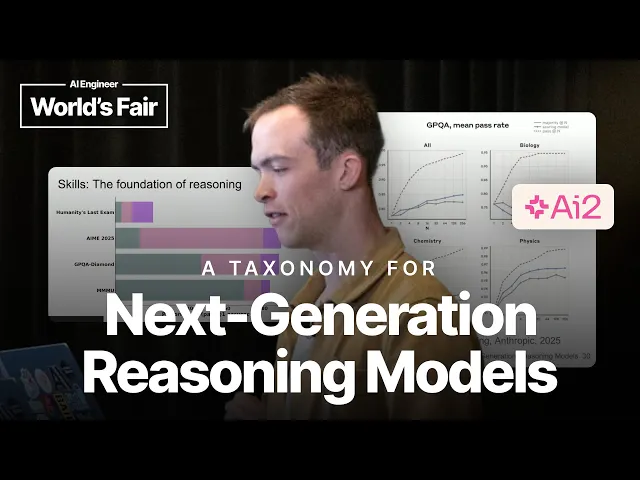
In the rapidly evolving landscape of artificial intelligence, reasoning capabilities represent the next frontier for large language models (LLMs). Nathan Lambert's presentation from the Allen Institute and Interconnects.ai offers a compelling framework for understanding different types of reasoning and how they manifest in modern AI systems. This taxonomy isn't just academic—it provides practical insights for anyone looking to leverage these systems more effectively in business applications.
The reasoning taxonomy: a map for the AI reasoning landscape
Lambert's presentation reveals a sophisticated understanding of how we should think about reasoning in AI systems:
-
Core reasoning types: Lambert identifies several fundamental reasoning patterns including chain-of-thought, least-to-most, and plan-and-solve approaches—each representing different ways LLMs can structure their thinking process to tackle complex problems.
-
Beyond simple prompting: The taxonomy demonstrates that reasoning isn't just about better prompts but about understanding the structural approaches to problem-solving that different techniques enable—whether decomposing problems into manageable chunks or generating step-by-step explanations.
-
Reasoning as computation: Lambert frames reasoning capabilities as computational processes, suggesting that reasoning is effectively how LLMs perform algorithmic thinking without traditional programming constructs.
-
Evaluation challenges: Perhaps most critically, Lambert highlights the difficulty in measuring reasoning capabilities, suggesting that our current benchmarks may not adequately capture the nuanced ways these systems actually reason.
The business implications of AI reasoning capabilities
The most valuable insight from Lambert's presentation is the recognition that reasoning in LLMs isn't a monolithic capability but rather a collection of distinct approaches that can be strategically deployed for different types of problems. This matters tremendously for business applications because it suggests that the future of AI implementation isn't just about having access to a powerful model—it's about knowing which reasoning technique to apply to which business challenge.
For example, when a financial analysis requires multi-step calculations, a chain-of-thought approach might yield more reliable results than standard prompting. Alternatively, when tackling complex planning problems, a system that can break down goals into sub-goals (least-to-most reasoning) might be more effective than one that attempts to solve everything at once.
This shift in understanding represents a significant evolution in how businesses should approach AI implementation. Rather than viewing LLMs as black-box solution generators,
Recent Videos
How To Earn MONEY With Images (No Bullsh*t)
Smart earnings from your image collection In today's digital economy, passive income streams have become increasingly accessible to creators with various skill sets. A recent YouTube video cuts through the hype to explore legitimate ways photographers, designers, and even casual smartphone users can monetize their image collections. The strategies outlined don't rely on unrealistic promises or complicated schemes—instead, they focus on established marketplaces with proven revenue potential for image creators. Key Points Stock photography platforms like Shutterstock, Adobe Stock, and Getty Images remain viable income sources when you understand their specific requirements and optimize your submissions accordingly. Specialized marketplaces focusing...
Oct 3, 2025New SHAPE SHIFTING AI Robot Is Freaking People Out
Liquid robots will change everything In the quiet labs of Carnegie Mellon University, scientists have created something that feels plucked from science fiction—a magnetic slime robot that can transform between liquid and solid states, slipping through tight spaces before reassembling on the other side. This technology, showcased in a recent YouTube video, represents a significant leap beyond traditional robotics into a realm where machines mimic not just animal movements, but their fundamental physical properties. While the internet might be buzzing with dystopian concerns about "shape-shifting terminators," the reality offers far more promising applications that could revolutionize medicine, rescue operations, and...
Oct 3, 2025How To Do Homeless AI Tiktok Trend (Tiktok Homeless AI Tutorial)
AI homeless trend raises ethical concerns In an era where social media trends evolve faster than we can comprehend them, TikTok's "homeless AI" trend has sparked both creative engagement and serious ethical questions. The trend, which involves using AI to transform ordinary photos into images depicting homelessness, has rapidly gained traction across the platform, with creators eagerly jumping on board to showcase their digital transformations. While the technical process is relatively straightforward, the implications of digitally "becoming homeless" for entertainment deserve careful consideration. The video tutorial provides a step-by-step guide on creating these AI-generated images, explaining how users can transform...