
Renowned artist Laurie Simmons is bringing AI-generated art to the iconic billboards of Times Square.
Project overview; “Autofiction: Moving Pictures,” a three-minute synchronized art display across 92 electronic billboards in Times Square, creates an unprecedented immersive experience at the crossroads of technology and traditional art.
- The installation debuts on December 20, 2024, at 11:57 PM, running nightly through December 30
- The display features AI-generated images of contemplative women in color-coordinated rooms, creating a meta-commentary as hundreds of viewers look up at screens showing AI women looking down at their phones
- The project represents a significant scaling of digital art in public spaces, utilizing Times Square’s massive electronic canvas

Technical approach; Simmons employs a hybrid methodology that combines cutting-edge AI technology with traditional artistic techniques.
- Three different AI platforms were utilized to generate new imagery based on Simmons’ artistic portfolio dating back to the 1970s
- The artist refined the AI-generated images through conventional methods including painting and embroidery
- This mixed-media approach demonstrates how AI can augment rather than replace traditional artistic processes
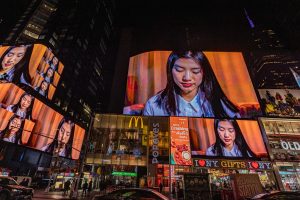
Artistic significance; The installation explores themes of reality, fantasy, and human connection in the digital age.
- The work continues Simmons’ long-standing artistic exploration of the boundaries between reality and fiction
- The choice of Times Square as a venue amplifies the project’s themes of technology, connectivity, and modern isolation
- The synchronized display creates a collective viewing experience that contrasts with the solitary figures depicted in the artwork.

Expert perspectives; Leading voices in the art world see this installation as indicative of broader shifts in artistic practice.
- Curator Hans Ulrich Obrist views the project as part of a larger trend where gaming technology and AI are expanding artistic possibilities
- The installation demonstrates how public spaces can be transformed into galleries for digital art
- Industry experts note that while AI enables new forms of creative expression, it functions as a complement to, rather than replacement for, traditional artistic media
Future implications; The success of this large-scale AI art installation in one of the world’s most prominent public spaces signals emerging possibilities for the integration of artificial intelligence in public art displays, while raising questions about the evolving relationship between human creativity and machine learning in artistic expression.
Recent Stories
DOE fusion roadmap targets 2030s commercial deployment as AI drives $9B investment
The Department of Energy has released a new roadmap targeting commercial-scale fusion power deployment by the mid-2030s, though the plan lacks specific funding commitments and relies on scientific breakthroughs that have eluded researchers for decades. The strategy emphasizes public-private partnerships and positions AI as both a research tool and motivation for developing fusion energy to meet data centers' growing electricity demands. The big picture: The DOE's roadmap aims to "deliver the public infrastructure that supports the fusion private sector scale up in the 2030s," but acknowledges it cannot commit to specific funding levels and remains subject to Congressional appropriations. Why...
Oct 17, 2025Tying it all together: Credo’s purple cables power the $4B AI data center boom
Credo, a Silicon Valley semiconductor company specializing in data center cables and chips, has seen its stock price more than double this year to $143.61, following a 245% surge in 2024. The company's signature purple cables, which cost between $300-$500 each, have become essential infrastructure for AI data centers, positioning Credo to capitalize on the trillion-dollar AI infrastructure expansion as hyperscalers like Amazon, Microsoft, and Elon Musk's xAI rapidly build out massive computing facilities. What you should know: Credo's active electrical cables (AECs) are becoming indispensable for connecting the massive GPU clusters required for AI training and inference. The company...
Oct 17, 2025Vatican launches Latin American AI network for human development
The Vatican hosted a two-day conference bringing together 50 global experts to explore how artificial intelligence can advance peace, social justice, and human development. The event launched the Latin American AI Network for Integral Human Development and established principles for ethical AI governance that prioritize human dignity over technological advancement. What you should know: The Pontifical Academy of Social Sciences, the Vatican's research body for social issues, organized the "Digital Rerum Novarum" conference on October 16-17, combining academic research with practical AI applications. Participants included leading experts from MIT, Microsoft, Columbia University, the UN, and major European institutions. The conference...