
Project Overview: Edtech Insiders has launched an expanded generative AI map and database that categorizes over 250 AI-enabled educational tools into distinct use case categories.
- The project builds upon an earlier mapping initiative created by education technology veterans Laurence Holt and Jacob Klein in 2023
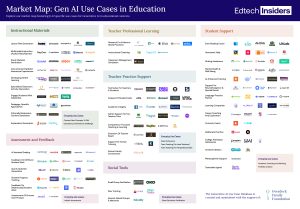
- The map organizes tools into six main categories: instructional materials, assessment and feedback, teacher practice support, teacher professional learning, student support, and social tools
- Only publicly available tools focused on K-12 education are included in the mapping system
Key Features and Functionality: The resource consists of three main components designed to help users understand and access AI educational tools.
- A visual map displays company logos representing tools with the largest reach in each use case category
- A comprehensive database provides detailed listings of AI-driven ed-tech tools for specific use cases
- A searchable directory offers information about the companies developing these tools
Current Landscape: The database reveals interesting patterns in the distribution of AI educational tools across different categories.
- Student support tools lead with 92 entries
- Instructional materials follow with 78 tools
- Teacher practice support includes 46 tools
- Assessment and feedback category contains 38 tools
- Teacher practice support has 10 tools
- Social purposes category remains smallest with 5 tools
Development and Evolution: The project has grown significantly from its initial conception to meet increasing demand for organized information about AI educational tools.
- The original map, posted on Medium in June 2023, gained significant traction among educators and developers
- The number of featured AI tools has more than doubled to 269 under Edtech Insiders’ management
- The team anticipates adding approximately 100 more tools in the coming months
Looking Forward: Market Gaps and Growth Potential: The mapping system not only showcases existing tools but also highlights areas where AI educational technology development lags, suggesting opportunities for future innovation in underserved categories like social tools and teacher practice support.
Recent Stories
DOE fusion roadmap targets 2030s commercial deployment as AI drives $9B investment
The Department of Energy has released a new roadmap targeting commercial-scale fusion power deployment by the mid-2030s, though the plan lacks specific funding commitments and relies on scientific breakthroughs that have eluded researchers for decades. The strategy emphasizes public-private partnerships and positions AI as both a research tool and motivation for developing fusion energy to meet data centers' growing electricity demands. The big picture: The DOE's roadmap aims to "deliver the public infrastructure that supports the fusion private sector scale up in the 2030s," but acknowledges it cannot commit to specific funding levels and remains subject to Congressional appropriations. Why...
Oct 17, 2025Tying it all together: Credo’s purple cables power the $4B AI data center boom
Credo, a Silicon Valley semiconductor company specializing in data center cables and chips, has seen its stock price more than double this year to $143.61, following a 245% surge in 2024. The company's signature purple cables, which cost between $300-$500 each, have become essential infrastructure for AI data centers, positioning Credo to capitalize on the trillion-dollar AI infrastructure expansion as hyperscalers like Amazon, Microsoft, and Elon Musk's xAI rapidly build out massive computing facilities. What you should know: Credo's active electrical cables (AECs) are becoming indispensable for connecting the massive GPU clusters required for AI training and inference. The company...
Oct 17, 2025Vatican launches Latin American AI network for human development
The Vatican hosted a two-day conference bringing together 50 global experts to explore how artificial intelligence can advance peace, social justice, and human development. The event launched the Latin American AI Network for Integral Human Development and established principles for ethical AI governance that prioritize human dignity over technological advancement. What you should know: The Pontifical Academy of Social Sciences, the Vatican's research body for social issues, organized the "Digital Rerum Novarum" conference on October 16-17, combining academic research with practical AI applications. Participants included leading experts from MIT, Microsoft, Columbia University, the UN, and major European institutions. The conference...