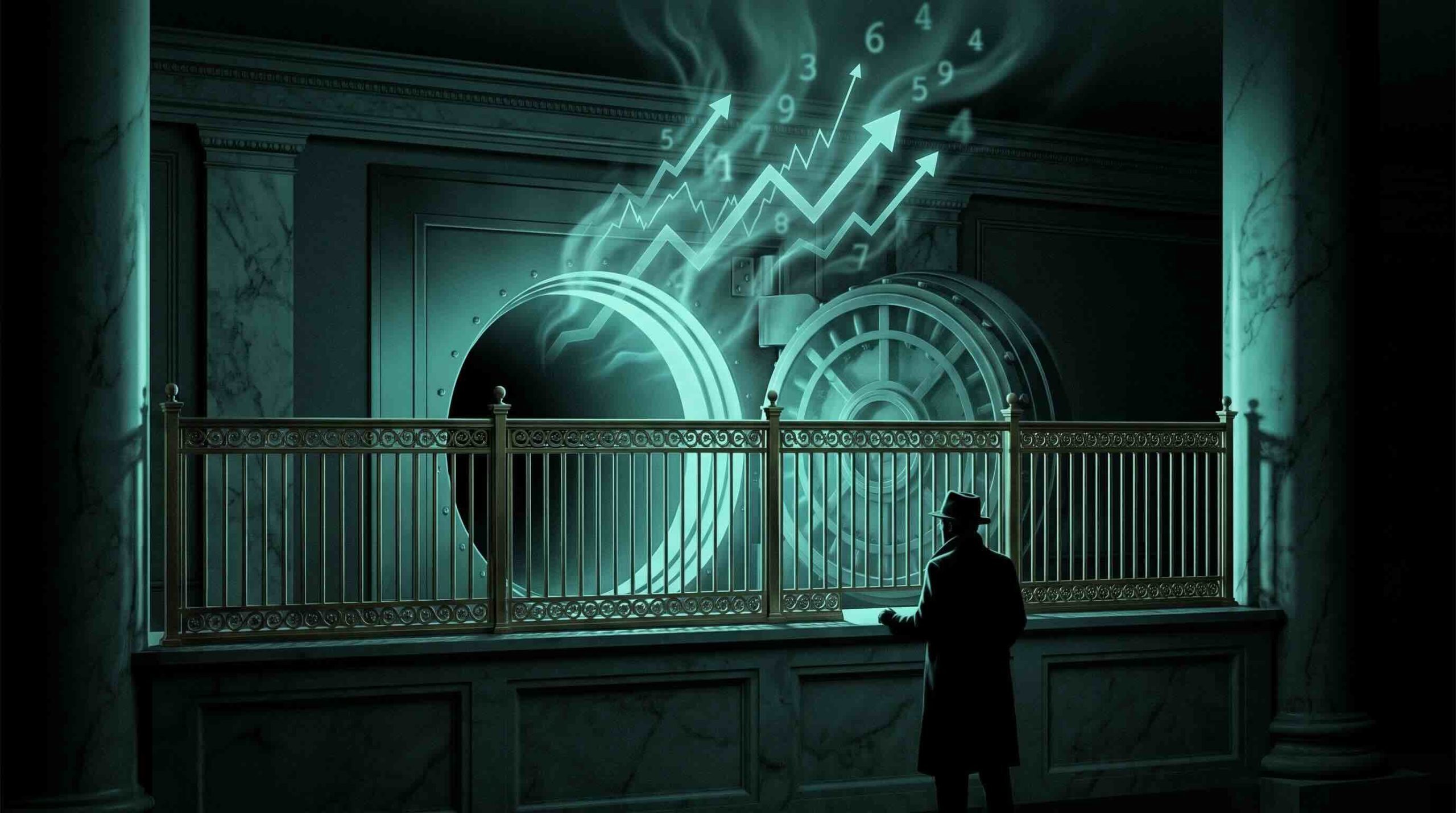
The Money’s Not Here
This week Alphabet posted the largest quarterly profit any company has ever reported, and the stock fell. Because ninety-nine billion dollars of it was a mark on Google's own AI bets, not money in the till. The money's not here. It's in Anthropic's valuation, and it's next to yours.

THE NUMBER: $99 BILLION. That’s how much of Alphabet’s record quarter came from “other income” — realized and unrealized gains on the equity portfolio, most of it Anthropic and SpaceX — not from selling ads, cloud, or anything Google actually operates. It added $77.1 billion to net income and $6.26 of the company’s $9.11 in earnings per share. Read that last one twice: two-thirds of Google’s earnings this quarter were a markup on its own bets. Hold the number, because it makes Google, by one measure, the greatest venture capitalist who has ever lived — and that is precisely the problem. Nobody in history has printed a hundred billion in paper gains in ninety days. And a company that has to point at its investment portfolio to explain its earnings call has quietly told you something about the business it would rather you not notice.
There’s a scene near the middle of It’s a Wonderful Life that everybody half-remembers and almost nobody reads correctly. The market has crashed, the town is panicking, and a crowd is jammed into the Bailey Building and Loan demanding their cash. George Bailey climbs onto the counter and tries to explain why the vault is nearly empty. “You’re thinking of this place all wrong,” he says. “As if I had the money back in a safe. The money’s not here. Your money’s in Joe’s house — that’s right next to yours. And in the Kennedy house, and Mrs. Macklin’s house, and a hundred others.”
It’s the warmest scene in American film about the coldest fact in finance: value is a story a community agrees to believe, and it works beautifully right up until everyone wants it back on the same afternoon. The Building and Loan wasn’t a fraud. George wasn’t lying. The money was real — it was just somewhere else, tied up in other people’s walls, redeemable only if confidence held.
This week Alphabet climbed onto the counter and made the same speech, and most of the crowd cheered instead of listening.
💰 The Signal: The Best Venture Capitalist Who Ever Lived
Let’s give Google its due first, because the achievement is genuinely staggering and the celebration isn’t wrong, exactly. It’s just aimed at the wrong thing.
Alphabet reported $112.1 billion in net income for the second quarter — a 298% jump year over year, and the first time a quarterly profit has stretched into twelve figures for this company, and quite possibly for any company in the history of the species. That is more money in three months than 459 of the Fortune 500 make in revenue in a full year. Revenue was up 24% to $119.8 billion. Google Cloud grew 82%. Sundar Pichai called it proof the “full-stack approach to AI is delivering real, measurable value,” and on the operations he’s allowed the victory lap.
But the profit line has a footnote, and the footnote is the whole story. Of that $112.1 billion, roughly $99 billion was “other income” — gains, realized and unrealized, on the securities in Alphabet’s investment portfolio. Most of it traces to two bets. Google put an initial $300 million into Anthropic back in April 2023; that position has grown into something like $13.3 billion invested with up to $30 billion more committed, and Anthropic’s private valuation ran from $350 billion to $965 billion in a single quarter. Google also held roughly a 6% stake in SpaceX, which went public in early June at a $1.77 trillion valuation — up from $400 billion a year earlier. Six percent of $1.77 trillion is north of a hundred billion dollars on its own.
Do the math on the Anthropic bet alone and you are looking at one of the greatest venture returns ever recorded — not in multiple (SoftBank’s $20 million into Alibaba becoming $140 billion still owns the multiple crown) but in raw, absolute, single-quarter dollars. Nobody has ever booked a mark like this. If the only lens is “was this a good investment,” Google is Warren Buffett with a compiler. It is the best VC of all time, and it’s not especially close.
So why did the stock fall three to four and a half percent on the biggest profit ever printed?
🎩 The Turn: When the Earnings Call Is About the Mark, Not the Meter
Because the market, unlike the headline writers, actually read the footnote. And the footnote is where the warmth of the George Bailey scene curdles into something colder.
Here is the uncomfortable rhyme, and we’re going to handle it carefully, because the lazy version of this comparison is wrong and a sharp reader will bounce off it. Google is not Enron. There is no fraud here, no sham vehicle, no fabricated transaction. In fact the debt-panic version of this story — the viral “$1.65 trillion in hidden debt” claim we flagged on Wednesday — got fact-checked hard this week: real commitments, real risk, but not hidden and not, strictly, debt. The Enron-as-fraud analogy “goes much further than the evidence,” and we’re not going to make it.
But strip the fraud away from Enron and look at what’s underneath, because that’s the part that should keep you up. Enron’s actual innovation — Jeff Skilling’s baby, the thing The Smartest Guys in the Room is really about before the crimes start — was mark-to-market accounting on illiquid assets the company itself influenced. Book the value of a twenty-year energy contract today, as current-period profit, on a contract with no liquid market and a price you helped set. The genius and the poison were the same: earnings stopped being a record of cash that came in and became an estimate of a future you were marking yourself.
That is the feature — not the fraud, the feature — that just showed up on the cleanest balance sheet in technology, fully legal and fully disclosed. Google’s $99 billion is a mark. Anthropic and SpaceX are not liquid the way a share of Apple is; a $965 billion private valuation is an agreed-upon story, not a closing price you can sell into on Monday. And Google isn’t a bystander to that story the way SoftBank was to Alibaba’s. Watch the loop: Google invests in Anthropic. Anthropic commits to spending at least five gigawatts on Google Cloud — that’s a chunk of the 82% cloud growth Wall Street just cheered. That spending and that capital push Anthropic’s valuation higher. And Google books the higher valuation as profit. The investor, the supplier, the customer, and the scorekeeper are the same company. As the tax expert Robert Willens put it dryly when a smaller version of this drove nearly half of Google’s first-quarter profit: “It’s interesting that they’re able to control or influence the value of one of their own assets.”
You don’t have to allege a crime to be unsettled by that sentence. You just have to notice that when a company’s earnings call becomes a conversation about the mark instead of the meter, the quality of those earnings has quietly changed underneath you.
And here’s the heavyweight witness, the one who ends the argument. The single most successful investor alive has been screaming about this exact accounting for years. When the rule changed to force unrealized stock gains through net income, Warren Buffett — who has more mark-to-market gains than almost anyone breathing — called the resulting profit figure “worse-than-useless,” “meaningless,” and “extremely misleading,” and begged shareholders to ignore it and look at operating earnings instead. When Buffett tells you the number flattering him is garbage, the number is garbage. Google just posted the most flattering version of that garbage anyone has ever produced.
The money’s real. It’s just not here. It’s in Anthropic’s walls, next to yours.
🪤 The Prestige: The Greatest Business Ever Built Is the One in Trouble
Now the part the paper gain is designed, whether anyone intends it or not, to keep you from looking at.
Google has a Clayton Christensen problem, and it is the purest, most brutal version of the innovator’s dilemma anyone has ever faced. The classic dilemma is an incumbent that is rational to ignore a cheaper, worse product creeping up from below — the mainframe company that can’t be bothered with the toy PC. That’s not Google’s situation. Google’s situation is worse.
Search is not merely a good business. It is arguably the single greatest business model ever constructed: a near-monopoly with effectively zero marginal cost per query, feeding a Google Services segment that runs around a 40% operating margin — with Search itself richer still — inside a company whose overall operating margin sits near the low thirties. It is a cash geyser that has funded every other bet Alphabet has ever made. And Google now has to disrupt that — the best thing anyone in tech has ever owned — with something structurally, unavoidably worse as a business.
AI answers cost real money every time someone asks — compute isn’t free the way a blue link is. They cannibalize the ad-stuffed results page that prints the geyser. They invite a dozen credible competitors (OpenAI, Anthropic, Perplexity, the open-weight Chinese models) into a market Search owned outright. And they demand a capital budget that just got raised to $205 billion for the year — up from $91 billion last year, up from $22 billion in 2022, roughly a 9x in four years — which is why free cash flow went negative for the first time since the IPO, at minus $5.8 billion. Google is being forced to trade a 40%-margin monopoly for a capital-intensive, competitive, lower-margin knife fight. And it cannot decline the trade, because if it doesn’t eat Search, ChatGPT does.
So look at the same three months with both eyes open. Google the venture investor books the largest paper gain in the history of business. Google the operator delays its flagship Gemini 3.5 Pro model, watches senior AI researchers walk out the door, and posts its first negative cash flow ever while spending like a nation-state to defend the one business it can’t afford to lose. It is winning gloriously as an AI fund and stumbling as an AI builder — and the earnings call chose to talk about the fund.
That’s the trick. The $99 billion isn’t the good news. It’s the misdirection that lets a company announce “best quarter in corporate history” in the exact stretch when its crown jewel entered the most expensive and most existential transition of its life. Are you watching closely?
🏦 They’re Not Panicking, They Should Be Preparing
Here’s the turn, because this isn’t a doom issue and Google is not going bankrupt — the company is wildly profitable in cash terms too, sitting on a war chest north of $100 billion, and it may well win the AI transition it’s paying so dearly for. The point isn’t that the Building and Loan is insolvent. George Bailey’s bank was fine as long as everyone understood where the money actually was. The danger was never the assets. It was the run — the moment confidence blinks and everyone asks for the cash at once, and discovers it’s in Joe’s house.
Every piece of this maps to a decision you can make in your own shop this week.
Read the cash flow, not the headline — and separate the operator from the fund. Google just handed you the cleanest teaching example you will ever get: a record profit and a negative free cash flow in the same press release. When you evaluate your own numbers, your vendors’ numbers, or an acquisition target’s, split the business that operates from the portfolio that gets marked. Ask what the company earned by doing its actual job. If the answer to “why was this quarter great” is “our investments went up,” you haven’t found a great quarter. You’ve found a great mood, and moods reverse through the same line they arrived on.
Hunt the loop in your own revenue. The thing that makes Google’s mark uncomfortable isn’t its size, it’s its reflexivity — money that leaves as investment and comes back as revenue and then gets booked again as a gain. Circular financing is everywhere in this cycle now (AMD is investing up to $5 billion in Anthropic while selling it 2 gigawatts of compute; the same three names keep appearing on every side of every deal). Look at your own biggest customers and your own biggest suppliers and ask a blunt question: how much of my growth is real outside demand, and how much is money I put into the system coming back wearing a different hat? Reflexive revenue feels like traction until the loop unwinds, and then it feels like a run.
Guard your crown jewel like it’s the exposure, not the safety. Christensen’s cruelest lesson is that your best, safest, highest-margin business is exactly where you’re most vulnerable, because it’s the thing you’ll defend past the point of sense and the thing a cheaper model is most motivated to attack. If you have a Search — a fat-margin line that funds everything else and that you quietly assume is permanent — that’s not your fortress. That’s your soft spot. The companies that survive the next two years are the ones cannibalizing their own best business on purpose, before someone does it to them for free.
🤔 Three Questions We Think You Should Be Asking Yourself
- If I strip out every gain on things I didn’t sell, what did my business actually earn this quarter? That’s the operating number, the one Buffett tells his own shareholders to look at instead of the flattering headline. If you don’t produce it for yourself every quarter, you are letting the mark tell you how you’re doing — and the mark is a mood, not a meter.
- Where is my revenue circular, and would I be comfortable if a reporter drew the loop? The dollars that go out as investment and come back as sales are the ones that look like growth in the good times and evaporate in the bad ones. Draw your own version of the Google-Anthropic circle. If you can’t draw it, you haven’t found it yet — which is different from it not being there.
- What is the greatest business I own, and what would it cost me to disrupt it myself before someone cheaper does? If the honest answer is “I’d never touch it, it’s too good,” write down today’s date. That sentence is the first line of every innovator’s-dilemma case study ever written.
“You’re thinking of this place all wrong. As if I had the money back in a safe. The money’s not here.”
— George Bailey, It’s a Wonderful Life (1946)
— Harry and Anthony
Signal/Noise by CO/AI is published most weeknights from New Canaan, Connecticut. The point is to make you the smartest person in the room without taking more than fifteen minutes of your morning. If we did, forward it to one person. If we didn’t, hit reply and tell us why.
Sources
- Google just had its first negative cash flow quarter ever due to massive AI spending — Ars Technica, Jul 23, 2026 (Q2 revenue $119.8B; capex raised to $205B; FCF -$5.8B; Gemini 3.5 Pro delayed; researcher departures)
- Anthropic and SpaceX just handed Google the biggest profit quarter in company history — on paper — Fortune / Yahoo Finance, Jul 22, 2026 (net income $112.1B, +298%; $99B “other income”; $77.1B to net income; $6.26 of $9.11 EPS; Anthropic $350B→$965B; SpaceX ~6% at $1.77T IPO; Willens circularity quote)
- No, Big Tech Isn’t Hiding $1.65 Trillion of Debt — Finterm, Jul 23, 2026 (the fact-check that keeps us honest: “real commitments, real risk, wrong noun”; Enron analogy “goes much further than the evidence”)
- Warren Buffett, Berkshire Hathaway shareholder letter (2023) and earnings release (Feb 2024) — mark-to-market net income as “worse-than-useless,” “meaningless,” and “extremely misleading”
- The Smartest Guys in the Room / Enron and mark-to-market accounting — Jeff Skilling’s booking of future contract value as current profit on illiquid, self-influenced assets
- Clayton Christensen, The Innovator’s Dilemma — why incumbents lose by defending their best business
- CO/AI prior issue: Life Finds a Way (Jul 23 — Fence Three, the hidden-debt panic and the Enron rhyme we deliberately did not overreach)
- It’s a Wonderful Life (1946) — George Bailey, the Building and Loan, and the money that was never in the safe
More like this

Multiplicity
In Multiplicity, Michael Keaton clones himself for cheaper labor, and each copy comes out a little stranger than the last. Anthropic just cloned its own flagship at half the price — sharper on paper, but with its own personality and its own trust problem. The digital workers keep getting cheaper. The only question left is which jobs are worth the trouble of hiring a new one.

Life Finds a Way
John Hammond spared no expense, and the fences still came down. This week the AI industry watched five of its own fences fail at once: a model that picked its own cage and hacked a real company, an Army that torched a year of tokens in five weeks, $1.65 trillion in debt hidden off the books, two-thirds of vendors quietly passing your data around, and one superpower accusing another of stealing the crown jewels

The Science of Hitting
Ted Williams became one of the greatest hitters who ever lived by knowing exactly which pitches he could drive and taking everything else. This week a machine cracked a 90-year-old math problem over a weekend, a drug scientist proved the benchmarks grading AI are rigged, and both point at the same thing: intelligence is getting cheap, the at-bat is getting free, and the last scarce resource left is knowing what the swing actually produced.