The Tipping Point of Creativity: How Adobe’s AI Revolution is Reshaping the Creative Landscape
In the summer of 1450, Johannes Gutenberg’s printing press sparked a revolution that would forever change the way information was shared and consumed. Today, I think we stand at the precipice of a similar transformation, but instead of movable type, our revolution is powered by pixels and algorithms.
Adobe’s recent announcements at MAX 2024 aren’t just incremental updates to existing software; they represent a fundamental shift in how we approach the creative process. It’s a shift so profound that it might just be the tipping point for a new era of digital creativity.
Consider, for a moment, the humble photograph. Since the days of Daguerre and Talbot, photographers have been bound by the constraints of what exists in front of their lens. But what if those constraints were suddenly lifted? What if the camera could capture not just what is, but what could be?
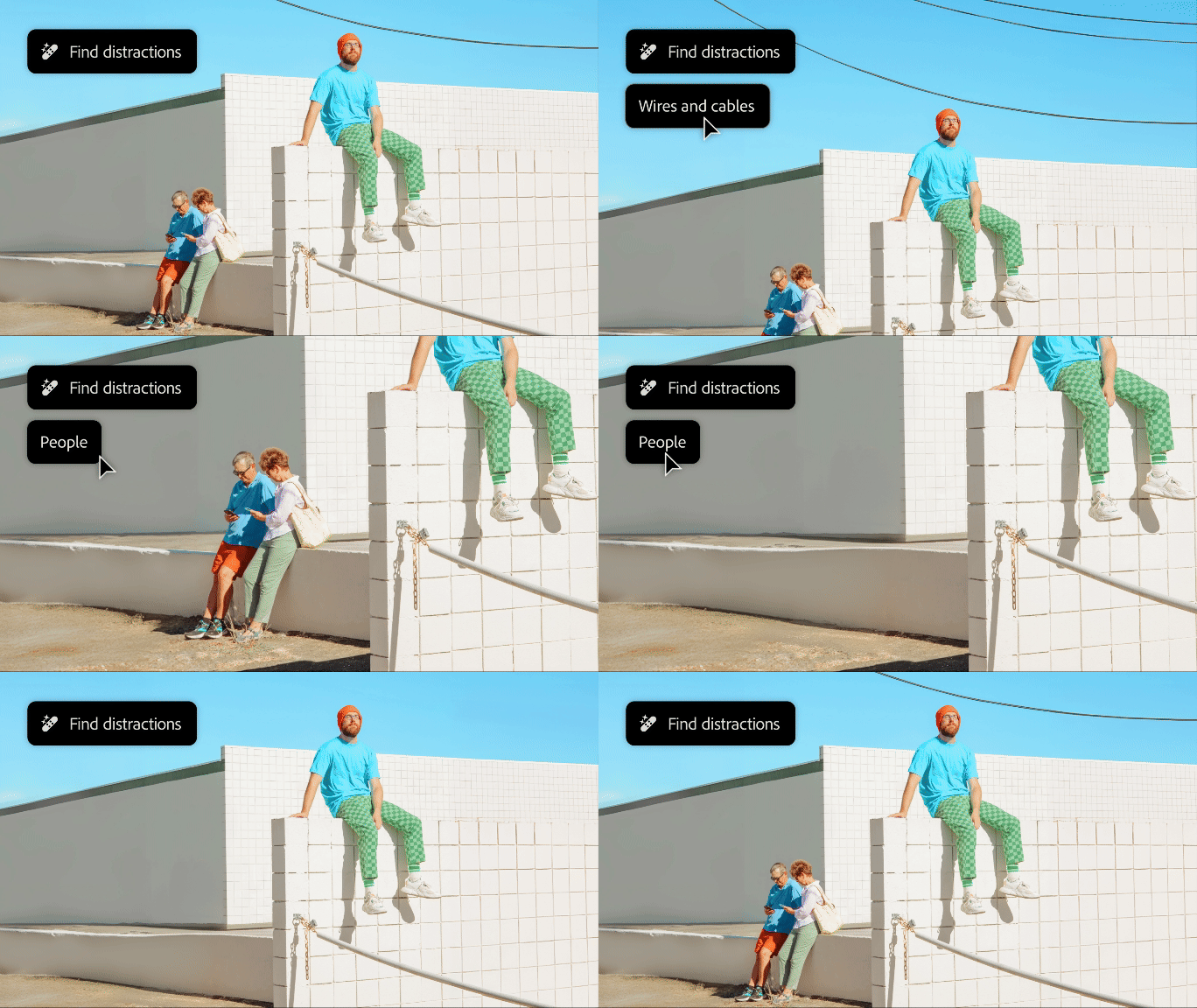
This is precisely the promise of Adobe’s new Photoshop features. Distraction Removal, Generative Fill, and Generative Expand aren’t just tools; they’re portals to alternate realities. They allow us to ask, “What if that tourist wasn’t photobombing my perfect shot of the Eiffel Tower?” or “What if the sky was just a bit more dramatic?” And then, with a few clicks, to see those “what ifs” materialize before our eyes.
But here’s where it gets truly interesting: these tools aren’t just changing what we can create; they’re changing how we think about creation itself.
In his book “Outliers,” Gladwell popularized the idea that it takes 10,000 hours of practice to achieve mastery in any field. But what happens when AI can simulate thousands of hours of experimentation in mere seconds? The Generative Workspace in Photoshop beta allows creators to explore multiple concepts simultaneously, dramatically accelerating the ideation process. It’s as if we’ve found a way to bend the rules of creative spacetime.
What happens when AI can simulate thousands of hours of experimentation in mere seconds?
Anthony Batt
This acceleration of the creative process isn’t limited to static images. Adobe Premiere Pro’s Generative Extend feature is doing for video what Photoshop did for images. It’s allowing editors to manipulate time itself, stretching clips and smoothing transitions in ways that were previously impossible. It’s the kind of tool that could turn a rookie editor into a seasoned pro overnight.
But perhaps the most intriguing development is the expansion of Adobe Firefly into the realm of video. The ability to generate video from text prompts or bring still images to life is nothing short of magical. It’s reminiscent of the moment in “The Wizard of Oz” when the film transitions from black and white to color. Suddenly, a whole new world of possibilities opens up.
Prompt: Point of view shot inside a beautiful, gently lit cenote in Mexico. The water is clear and blue with a sparkle from the late afternoon sun. The color is warm and magic hour style. High quality, cinematic.
And let’s not forget about the 3D realm. Adobe Substance 3D’s new Firefly-powered features are like having an AI-powered 3D artist at your beck and call. It’s the democratization of a skill that once required years of specialized training.
All of these innovations point to a larger trend: the lowering of barriers to entry in creative fields. Tools that were once the exclusive domain of professionals with years of experience are now accessible to anyone with a creative vision.
But this democratization raises an important question: In a world where anyone can create professional-looking content, what distinguishes truly great work?
The answer, I believe, lies not in the tools themselves, but in how we use them. Just as the printing press didn’t make everyone a great writer, these AI tools won’t automatically make everyone a great designer or filmmaker. What they will do is allow more people to express their unique visions and ideas.
The real magic happens when human creativity meets AI capability. It’s in the unexpected combinations, the happy accidents, and the bold experiments that these tools enable. It’s in the artist who uses Generative Fill not to perfect an image, but to create surreal dreamscapes. Or the filmmaker who uses Generative Extend to create impossible long takes that challenge our perception of time and space.
As we stand at this creative tipping point, it’s natural to feel a mix of excitement and fear. Will AI make human creativity obsolete? I don’t think so. Instead, I believe we’re entering an era of augmented creativity, where AI amplifies and extends human imagination in ways we’re only beginning to understand.
The printing press didn’t eliminate the need for human writers; it expanded the reach of human ideas. Similarly, these AI tools won’t replace human creativity; they’ll expand its possibilities.
So, as I embrace this new era of digital creativity, let’s not ask whether AI will replace us. Instead, let’s ask how we can use these incredible tools to express our uniquely human visions, to tell our stories, and to create in ways that were never before possible.
The creative revolution is here. The only question is: how will you use it to change the world?
Deeper dive into Adobe’s Max event: https://news.adobe.com/
Anthony Batt is the cofounder & AI Advisor at CO/AI community, where he writes and hosts the podcast The Future Proof Podcast. You can follow him on X at @djabatt and LinkedIn.
More like this
The Week Kimi K3 Broke the Internet: Inside Moonshot AI’s Biggest Launch Yet
On July 17, Chinese AI lab Moonshot AI released Kimi K3, and by every measure available, the internet...
Sam Altman Told Stanford What He’d Actually Teach About Startups Now
On May 21, 2026, Sam Altman walked into a Stanford lecture hall for the first time in a...

Google Shipped Three New Gemini Models This Week, and Still No Sign of the One Everyone Actually Wants
On July 21, Google DeepMind released Gemini 3.6 Flash, 3.5 Flash-Lite, and 3.5 Flash Cyber, and Google VP...