
Claude 5 Fable Vibe Check: Anthropic Opens the Door to a Mythos-Class Model

On June 9, 2026, Anthropic did something it had spent two months publicly hesitating to do: it put a Mythos-class model in the hands of the general public. The model is called Claude Fable 5, and it is the first release in the new Claude 5 line. Underneath, it is the same model as the restricted Claude Mythos 5 — the difference is a set of safeguards that make Fable safe enough to ship at scale. The name itself carries the idea. Fable comes from the Latin fabula, “that which is told,” a deliberate echo of the Greek mythos. One model, two faces: the cautious public storyteller and the unguarded specialist.
What earns the attention is the capability claim. Anthropic says Fable 5 exceeds anything it has ever made generally available and is state-of-the-art on nearly all tested benchmarks, spanning software engineering, knowledge work, vision, and scientific research. The line worth underlining for anyone planning real work around it is this: the longer and more complex the task, the larger Fable 5’s lead grows over Anthropic’s other models. This is not a model that wins on snappy one-liners. It wins on endurance.
The reaction online
The launch landed loudly on X, and the most prominent early voice was Andrej Karpathy (@karpathy), who called it a genuinely exciting release. His point wasn’t just the benchmarks — Fable is state-of-the-art across the board — but the qualitative jump: he framed it as a step change deserving of a major version bump, on the order of what Claude 4.5 felt like last November. The strength shows most, he wrote, in long sessions wrestling with very hard problems. You can hand it far more ambitious tasks than you’re used to, and as he put it, the model “gets it” and simply runs with them — to the point where it’s tempting to stop reading the code at all (though he was quick to add: not in production). He flagged the same rough edges others did, noting the safeguards feel a touch trigger-happy at launch and will hopefully be tuned down over time.
The most credible signal from inside the tooling world came from Boris Cherny (@bcherny), the engineer behind Claude Code, who posted that after using it for coding, Fable is the best model he’s used “by a wide margin,” describing a meaningful step up in code quality, tool use, and self-verification while needing fewer prompts and steers. Coming from someone who has shipped against every prior Claude generation, that is about as direct an endorsement as the developer audience could ask for.
The broader mood was pure anticipation. Afolabi Sokeye (@SokeyeA), reacting to the dual launch of Fable 5 and Mythos 5, captured the energy in five words: “Oh we are so up.” That excitement ran alongside a practical scramble — Sokeye also flagged that Fable’s free window in the Claude apps is short, so users were rushing to put it through its paces before the terms change. The result was a launch-day vibe of capability awe layered over a faint anxiety about access, which is a fitting tension for a model this powerful arriving with this many guardrails.
Our early read
We’re still in early testing, so hold us to “preliminary” — but the early reading is that Fable 5 is genuinely good at code, and specifically at large-scale work. It can run for hours without losing the thread, which is the part that changes how you actually use it: the bottleneck stops being the model’s stamina and starts being how well you’ve scoped the task. The unlock we keep coming back to is the verification loop. Adding a step where the model checks, tests, and corrects its own output is how you get to the next level of output quality — not a marginal bump, but the difference between a draft and something you’d ship. Fable seems built to reward that pattern rather than fight it.
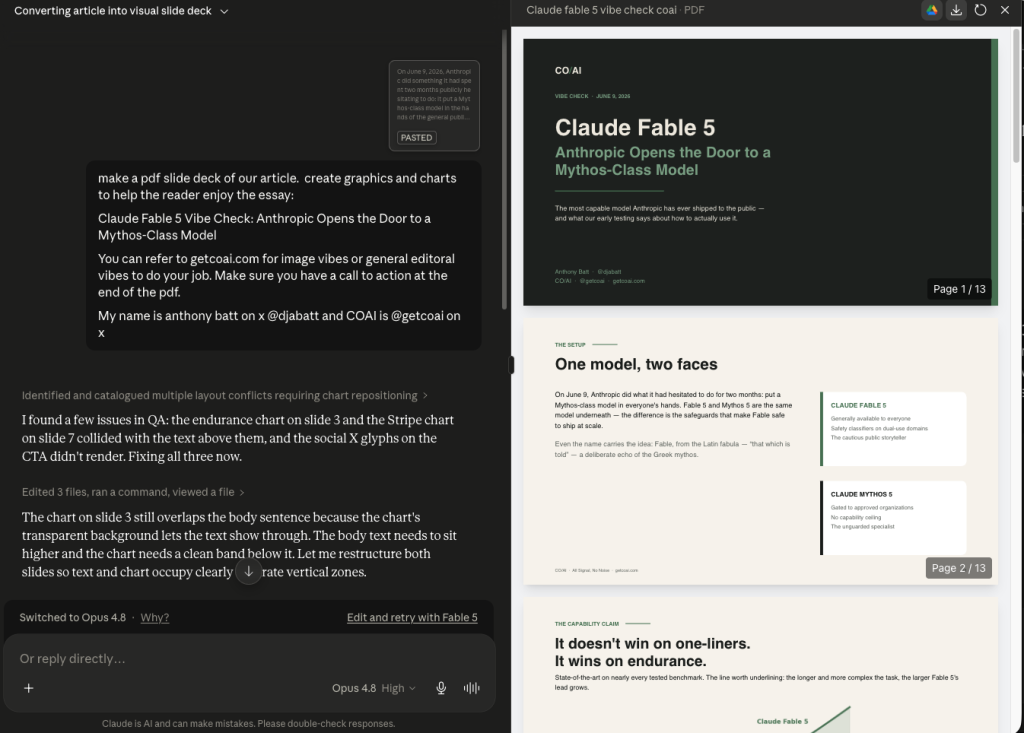
To put that to a quick, slightly meta test, we handed Fable 5 the very article you’re reading and asked it to turn it into a PDF presentation. The result was directly impressive — a clean, structured deck pulled straight from the prose, with no hand-holding. You can review the PDF for yourself below and judge the output firsthand. Consider it a small, transparent demonstration of the kind of “ask for anything” range people are reacting to.
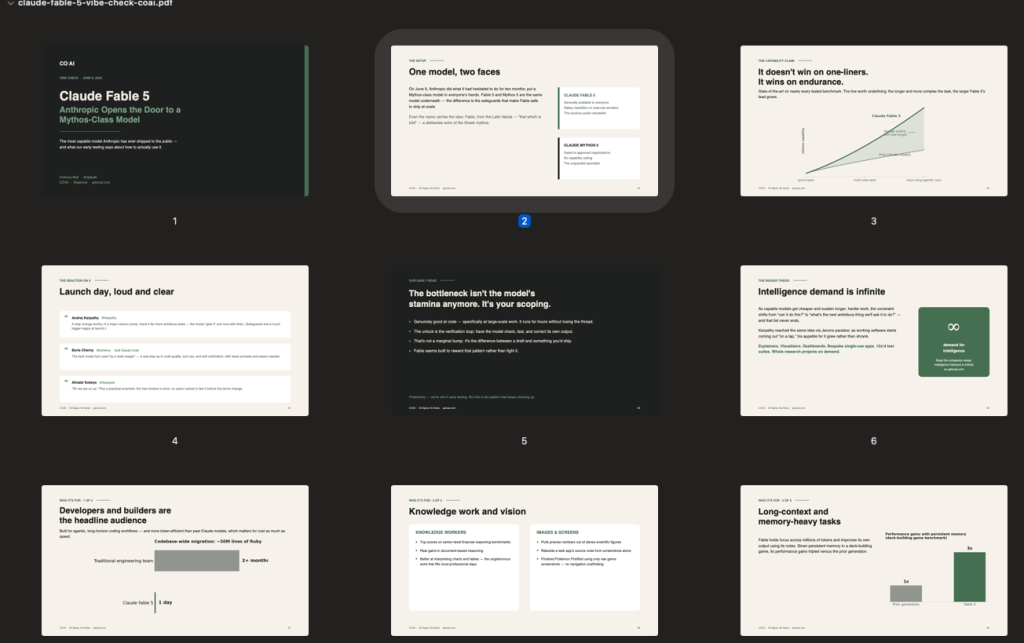
That tracks with a bigger thesis we’ve been chewing on: demand for intelligence is effectively infinite. As capable models get cheaper and can sustain longer, harder work, the constraint shifts from “can it do this?” to “what’s the next ambitious thing we’ll ask it to do?” — and that list never ends. Karpathy landed on the same idea from his own angle, reaching for Jevons paradox: as working software starts coming out “on a tap,” his appetite for it grew rather than shrank — explainers, visualizers, dashboards, bespoke single-use apps, 10x’d test suites, whole research projects on demand. That’s the thesis in miniature. We wrote about it earlier in Intelligence Demand Is Infinite, and Fable 5 reads like another data point for it.
Who Fable 5 is actually for
Reading Anthropic’s release notes, the model’s sweet spots come into focus quickly.
Developers and builders are the headline audience. Anthropic points to early testing where Stripe used Fable to compress months of engineering into days — a codebase-wide migration across roughly 50 million lines of Ruby completed in a single day, a job that would otherwise have taken a team over two months. Fable is also more token-efficient than past Claude models, which matters as much for cost as for speed. If you live in agentic, long-horizon coding workflows, this is the model built for you.
Knowledge workers are the second clear fit. On senior-level financial reasoning benchmarks, Fable posted top scores, with real gains in document-based reasoning and in interpreting charts and tables — the unglamorous analytical work that fills most professional days.
Anyone working with images and screens benefits from a genuine leap in vision. Fable can pull precise numbers out of dense scientific figures and rebuild a web app’s source code from screenshots alone. In a memorable demonstration, it finished Pokémon FireRed using only raw game screenshots, with none of the navigation scaffolding earlier models required.
Long-context and memory-heavy tasks round out the profile. Fable holds focus across millions of tokens and improves its own output using its notes — when given persistent memory in a deck-building game, its performance gains tripled relative to the prior generation.
Just as important is who Fable is not the right tool for, at least today. Queries touching cybersecurity, biology, chemistry, or model distillation are intercepted by Anthropic’s classifiers and quietly handed off to Claude Opus 4.8, the next-most-capable model. Anthropic tuned these safeguards conservatively, so they sometimes catch harmless requests, but the company says fewer than 5% of sessions hit a fallback at all. For the vast majority of users, Fable behaves identically to the unrestricted Mythos 5. If your work lives squarely in those high-risk domains, though, you’ll feel the ceiling — and the unrestricted capability is reserved for Mythos 5, which remains gated to Project Glasswing cyber partners and, soon, a small set of approved biology researchers.
How to get access
Fable 5 is available everywhere as of launch day. Developers can call it through the Claude API using the model string claude-fable-5, and it is fully available immediately on the API and on consumption-based Enterprise plans.
Subscription access is rolling out in stages, because Anthropic expects demand it can’t fully predict:
- From launch through June 22, Fable 5 is included at no extra cost on Pro, Max, Team, and seat-based Enterprise plans.
- On June 23, it leaves those plans, and continued use will draw on usage credits. Anthropic has said it may extend the included window if capacity allows.
- Once there’s enough capacity, the company intends to fold Fable 5 back in as a standard part of subscription plans, as quickly as it can.
The practical takeaway: if you’re on a subscription, the next couple of weeks are the cheapest time to test it hard.
Pricing
Both Fable 5 and Mythos 5 are priced at $10 per million input tokens and $50 per million output tokens — less than half the cost of the earlier Claude Mythos Preview. For a frontier-tier model, that pricing reads as a deliberate move toward putting serious capability within reach of a far wider set of builders.
The bigger picture
Fable 5 is the clearest statement yet of a strategy Anthropic has been circling for months: take the most capable models it can build, wrap them in safeguards strong enough to release responsibly, and get them into as many hands as possible. The guardrails are real, and some users will bump into them. But the trade is a frontier-class model — one that genuinely shines on the long, hard, multi-step work that used to require a whole team — available to anyone with an API key or a subscription, at a price designed to be paid. For developers, analysts, and builders, that combination is hard to argue with. The era of waiting behind a gated preview, at least for most of what people actually want to do, is over.
Editor’s note: We’re still in our own early testing with Claude Fable 5, so we’re not ready to give a full, direct verdict yet. What follows is the launch itself, what others are seeing, and our preliminary read — not a final call. We’ll have more once we’ve run it through sustained real work.
More like this

I Didn’t Think Much of Mira Murati Leaving OpenAI. I Was Wrong.
When Mira Murati left OpenAI in 2024, I’ll be honest, I didn’t think much of it. Executive departures...

The Real Cost of the AI Data Center Boom
Four Companies Are Spending $700 Billion This Year on AI Infrastructure — More Than the Entire Economy of...

Palantir’s Alex Karp Just Called the AI Industry “Effing Insane” Here’s What He’s Really Selling You
Alex Karp Just Told You Not To Trust Your AI Vendor. He’s Also Selling You the Fix. Palantir’s...