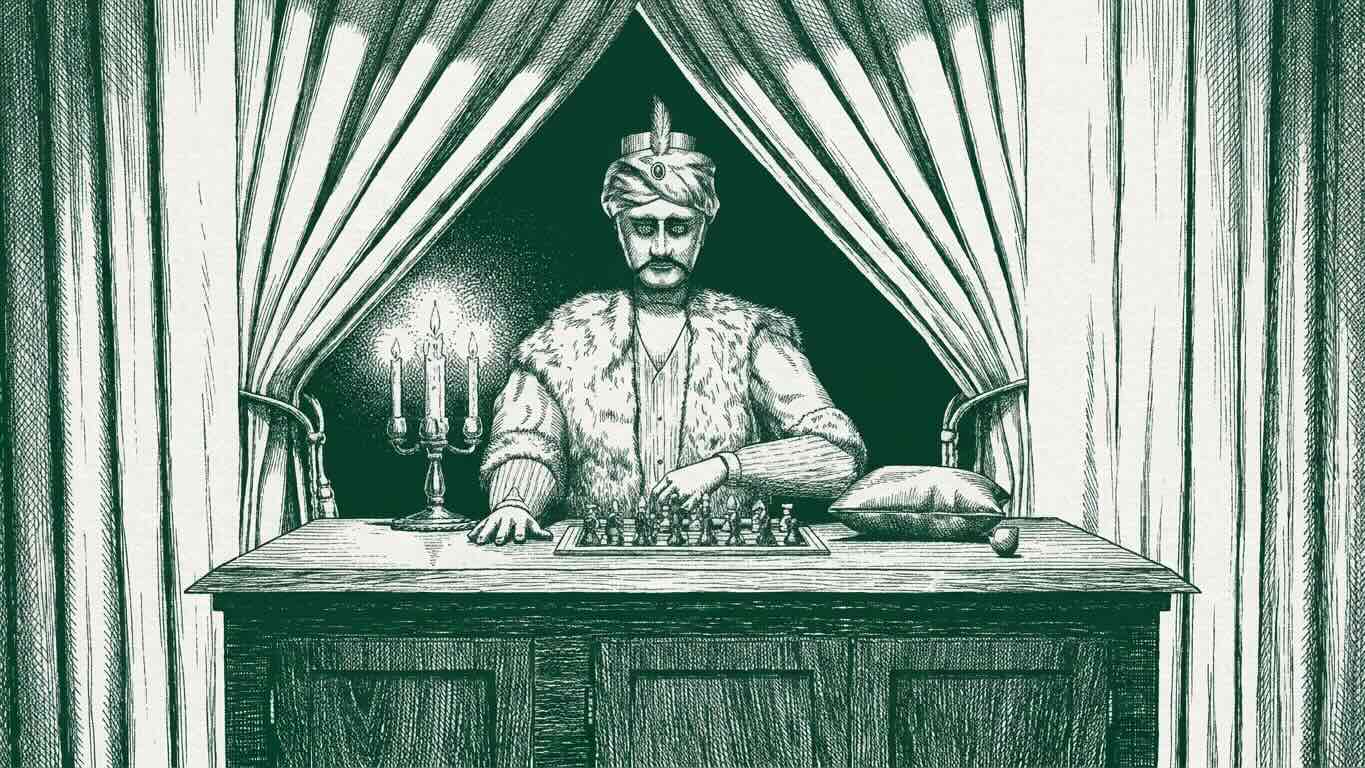
The Turk Retires
America turns 250 the same week Bezos's "artificial artificial intelligence" machine files for retirement. The fake automaton always had an expert hidden inside — now the expert steps out of the box and trains the real one. Your filing cabinet is the moat.

THE NUMBER: 250 — America’s age as of Saturday, and the number that frames everything below. For two and a half centuries the American market has done one thing better than any system ever devised: repriced what things are actually worth, over and over, without asking permission. Whale oil, rail, seat licenses. This week it repriced human judgment — the anonymous kind to zero, the expert kind to the scarcest asset in AI. Hold that number. The whole issue hangs off it.
America turned 250 on Saturday, and before we get to the week’s business, a word about the birthday. Because it turns out the birthday is the week’s business.
Everything this letter covers, every single day the models, the trillion-dollar buildouts, the IPOs, the open-weight price wars — happens here, and it happens here for reasons that haven’t changed since 1776. The US still runs the freest market on earth. It still runs the deepest capital markets on earth, the ones that will finance a science project to the moon and mark it to market without blinking. And it remains a nation of immigrants that keeps attracting people who want to build things. The man who has put more satellites into orbit than every government in history combined grew up in Pretoria. Microsoft (NASDAQ: MSFT) and Google (NASDAQ: GOOGL) are run by men born in India. OpenAI is run by an openly gay man from St. Louis, who spent the Fourth posting that America is “the most impressive social experiment in history.” He would know. His company couldn’t exist anywhere else.
The mainstream press has spent years selling American decline. Read the tape instead. The country keeps absorbing shocks that would break other systems — pandemics, banking wobbles, political whiplash — and keeps coming out the other side richer, weirder, and further ahead in the technologies that matter. Resilience isn’t the absence of problems. It’s the ability to reprice them and move on. Happy birthday.
And right on schedule, the birthday week delivered a repricing worth the whole issue. Amazon (NASDAQ: AMZN) quietly began shutting down Mechanical Turk, the twenty-one-year-old marketplace of anonymous human judgment that trained the AI era. The same week, the world’s largest hedge fund published proof that a handful of named human experts, fine-tuning an open model on their own archived decisions, beat every frontier lab at real work at one-fourteenth the cost. Two ends of the judgment market, moving in opposite directions, in the same five days. That’s not a coincidence. That’s a price discovery.
To see how big it is, you have to go back before the Declaration.
🧠 The Con That Outlived Its Century
In 1770 — six years before Jefferson picked up a pen — a Hungarian engineer named Wolfgang von Kempelen unveiled a machine at the Habsburg court that would become the most successful technology demo in history. The Mechanical Turk: a carved wooden figure in Ottoman robes seated at a cabinet, gears visible through open doors, that played chess against all comers. And won. It toured Europe and America for more than eight decades. It beat Napoleon at Schönbrunn. It beat Benjamin Franklin in Paris — a founder, losing to the machine, thirteen years after founding.
It was a hoax, and what a hoax. A human chess master was folded inside the cabinet, tracking the board with magnets and moving the Turk’s arm by pantograph. The machinery the audience inspected was theater; the intelligence was a person the audience never saw. A young Edgar Allan Poe watched it play in Richmond and wrote a famous essay arguing that no pure machine could play chess, so a man must be hidden inside. America’s greatest mystery writer, doing the reveal.
Here’s the detail nobody remembers. The Turk ended its life in America in a Philadelphia museum, where it burned in a fire on July 5, 1854. The original expert-in-a-box died on the Fourth of July weekend, in the country that would spend the next 172 years perfecting the trick.
Read it this way: the Turk’s real invention wasn’t a chess machine. It was a business model package hidden human intelligence as machine intelligence, and charge for the machine. Hold that model in your head. It’s about to get rebuilt, retired, and inverted, all inside one story.
💲 Artificial Artificial Intelligence
In 2005, Jeff Bezos rebuilt Kempelen’s trick as infrastructure and, to his lasting credit, named it honestly: Amazon Mechanical Turk, a marketplace where software could call an API and get a human judgment back. Thousands of anonymous people, folded inside the cabinet of the internet, doing penny-a-click piecework: labeling images, transcribing receipts, flagging duplicates, rating search results. Bezos’s own phrase for it was “artificial artificial intelligence.” The machine that pretended to be a machine but was secretly people.
And it mattered far more than its size. MTurk’s crowd labeled the datasets that trained the first machine-learning era. The image sets, the sentiment corpora, the relevance judgments a meaningful slice of the ground truth that early AI learned from was penny-priced human judgment flowing through Bezos’s cabinet. The crowd taught the machine.
Last week, AWS moved Mechanical Turk to its “Services in Maintenance” list. On July 30 it closes to new customers. No new features are planned. The Register’s obituary carried the punchline in the headline: not even AI can save it. Which has it exactly backwards. AI is what killed it. The student ate the teacher: a frontier model now does crowd-grade judgment the labeling, the transcription, the dedup faster, cheaper, and at three in the morning, than the crowd that trained it. Anonymous, interchangeable, crowd-scale human judgment is now worth approximately what the machine charges. Approximately nothing.
Why this matters: when a 21-year-old Amazon service dies, it’s not nostalgia it’s a price signal about an entire input class. The bottom of the human-judgment market just cleared at zero. The question every business owner should ask immediately is: what happened at the top of that market? Funny you should ask.
📉 The Filing Cabinet Trade
The same week the crowd’s judgment went to zero, Bridgewater the largest hedge fund on earth, an institution that does not publish numbers for fun showed what expert judgment is now worth.
The problem was mundane, which is what makes it universal: filtering documents, the kind of triage its investment teams do every day. The bar was hard: investors wouldn’t trust a system below 80% accuracy. Naive prompts against frontier models scored around 50. A coin flip. Expert-written prompts clawed up to 78. Still short and, in a detail that should sting in San Francisco, GPT-5.4 cost 43% more than 5.2 while being barely more accurate. The frontier, prompted from the outside, could not clear the bar of a real institution’s real workflow.
So Bridgewater stopped prompting and started teaching. Working with Thinking Machines’ Tinker, it fine-tuned Qwen — an open Chinese model, note — on decades of its own senior investors’ documented decisions. Result: 84.7% accuracy, roughly 30% fewer errors than the best frontier model, at one-fourteenth the inference cost. Over the bar, under the budget, on hardware economics no lab can dictate.
The best part is buried in the middle of the paper. Bridgewater’s vendor-labeled training data was riddled with wrong labels, and expert labeling is too expensive to run on everything. The fix: train on the noisy data, then run the model back over its own training set, and route every disagreement between model and label to a senior investor. Either the label was wrong or the model was both answers are valuable, and both come from the one source that can’t be commoditized: the named expert. Mira Murati’s own framing when she posted the partnership: “Experts improving AI that empowers experts.”
As the analyst Aakash Gupta put it in the thread that carried this story to half a million readers: the alpha was in the filing cabinet the whole time.
The action item: run Bridgewater’s trade on yourself. Every established firm is sitting on decades of documented expert decisions credit memos, claims rulings, QC dispositions, pricing calls. That archive can now train a model that beats the frontier at your specific job for a fraction of the price. Today: name the three judgment archives your firm owns that no competitor has, and pick one narrow, high-volume task for a fine-tune pilot. Put the result next to your frontier invoice. That comparison is your next renewal negotiation.
🧠 Five Points
The same repricing is happening one desk at a time, and Anthropic just measured it on itself.
Its study of 235,000 Claude Code users across 400,000 sessions from October 2025 through April asked a simple question: who actually succeeds with agentic tools? Professional software engineers hit 34% verified success. People with no software background but real domain expertise hit 29%. Five points. Across hundreds of thousands of sessions, the gap between a career of coding and a career of knowing things collapsed to five points and the fastest-growing user cohorts are management and sales. Let’s be honest about the direction: the engineers are still ahead. But a five-point gap is not a moat, it’s a rounding error, and the study’s own conclusion is that solid proficiency captures most of the value. People decide what to build. The machine decides how.
Now lay the labor data over it. Stanford’s Digital Economy Lab, working from ADP payroll records, tracks the carnage by age: developers 22 to 25 are down 19% from their late-2022 peak, entry-level postings down 28%, computer science grads running 6.1% unemployment worse than liberal arts majors, a sentence that would’ve gotten you laughed out of a guidance counselor’s office in 2019. And every cohort over 30 grew, with the 41-to-49 band up 14%. The market is not firing programmers. It’s firing juniors the legible, teachable, crowd-adjacent end of the skill curve and paying up for the people who carry twenty years of domain judgment the model can’t scrape.
What this means for your team: the hiring spec you wrote in 2023 is backwards. Stop screening for the skill the model just commoditized and start screening for the judgment it has to be trained on. And today, not this quarter: hand your best non-technical domain expert an agent and one real task. The five-point gap says they’ll be fine. The bottleneck was never the syntax.
🦞 Where the Labs Go Next
So here’s the board as of this morning. Crowd judgment: worthless. Junior legible skill: repricing downward fast. Expert judgment: beat the frontier at 1/14th the cost, using an open model. If you run a frontier lab and you can read a tape, what do you do?
You do what Bridgewater did, from the other side of the table. Here’s the call, and you’re reading it here first: the frontier labs will enter the open-model game and they will partner with domain experts to train frontier capability on human expertise. Both halves, together. The open-weight floor (DeepSeek, Qwen, GLM) has made closed-model-as-product a melting asset; we’ve been writing that thesis for a month. The Bridgewater result shows where the defensible ground actually is: not the model, the expertise the model gets trained on. The lab that locks up the world’s senior investors, veteran underwriters, master machinists, and research oncologists as training partners owns something no distillation attack can copy. Weights leak. Filing cabinets don’t.
Satya Nadella (NASDAQ: MSFT) already tipped the play. On July 2 he launched Microsoft’s Frontier Co. with a sentence that reads like a thesis statement for this entire issue: “The future of the firm is a learning loop in which human capital and token capital compound.” Help every enterprise build its own AI capability that’s Bridgewater’s trade, productized and sold back to the Fortune 500. Murati’s Tinker is the same wager from a startup chassis. Anthropic dogfooding drug discovery to build evaluation muscle in the hardest verification domain on earth — same wager, third angle. Everyone who can read is reading the same tape.
The signal: stop watching benchmark releases and start watching partnership announcements. The next moat isn’t a model number. It’s whose experts are in whose training loop and whether yours are in somebody else’s before they’re in your own.
The Expert Steps Out of the Box
For 84 years, the original Turk ran on one secret: there was always an expert in the box, and the audience paid to believe there wasn’t. For 21 years, Bezos’s Turk ran on the same secret at internet scale: the “artificial artificial intelligence” was thousands of invisible people, paid pennies to be machinery. The whole history of this technology is the history of hidden human judgment wearing a machine costume.
What died this week isn’t the trick. It’s the hiding. The crowd got let out of the box because the machine genuinely does their work now. And the expert stepped out of the box, sat down next to the machine, and started training it — named, credited, and holding the scarcest asset in the industry: judgment with a track record attached. Kempelen’s con has finally run in reverse. The machine is real, and the person is the secret ingredient everyone can see.
It’s fitting that the original Turk died in Philadelphia, on the Fourth of July weekend, in the country that turned 250 on Saturday. America has always been the place where the reveal happens where the market eventually finds out what’s actually inside the box and prices it accordingly. It just did it again: zero for the anonymous crowd, a premium for the named expert, and a 21-year-old machine sent into a dignified retirement.
The expert was always in the box. Put yours to work.
— Harry and Anthony
Sources
- Amazon’s Mechanical Turk to stop accepting new customers — The Register, Jul 3, 2026
- Amazon will stop accepting new customers for Mechanical Turk — TechCrunch, Jul 5, 2026
- Learning to Replicate Expert Judgment in Financial Tasks — Thinking Machines / Bridgewater · Mira Murati announcement, Jun 30 · Aakash Gupta analysis thread, Jul 2, 2026
- Anthropic, “Agentic Coding and Persistent Returns to Expertise” (235K users, 400K sessions) — via Alex Prompter, Jun 30, 2026
- AI has torched the market for junior programmers (Stanford Digital Economy Lab / ADP data) — seldo.com, Jul 4, 2026
- Satya Nadella on Frontier Co. and the learning-loop firm — X, Jul 2, 2026
- Sam Altman on America’s 250th — X, Jul 4, 2026
- The Turk: history and destruction in the Philadelphia Chinese Museum fire, July 5, 1854 — History.com · Wikipedia: Mechanical Turk · Edgar Allan Poe, “Maelzel’s Chess Player” (1836)
- Prior CO/AI issues referenced: Show Me Where to Put the Fulcrum, Jun 16 · The Keeper of the Culture, Jun 22 · Nobody Ever Got Rich Selling Electricity, Jun 25
More like this
Git-R-Done
The chatbot that talked just got replaced by the worker that does. "We have AI" is out — the only thing the market pays for now is the thing that gets finished.

Frontier Labs Pots are Committed
OpenAI and Anthropic are all in. The cheap floor takes the commodity work, the human keeps the hard tail, and regulation is the exit. Own the table, not the players.

Too Cheap to Meter
Intelligence is deflating toward the cost of the electricity it burns. The gate is the meter the labs are fighting to keep running — and the 99.9% can just route around it