Diamond Hands Are Bidding On Pez Dispensers. The Husks Are About To Run.

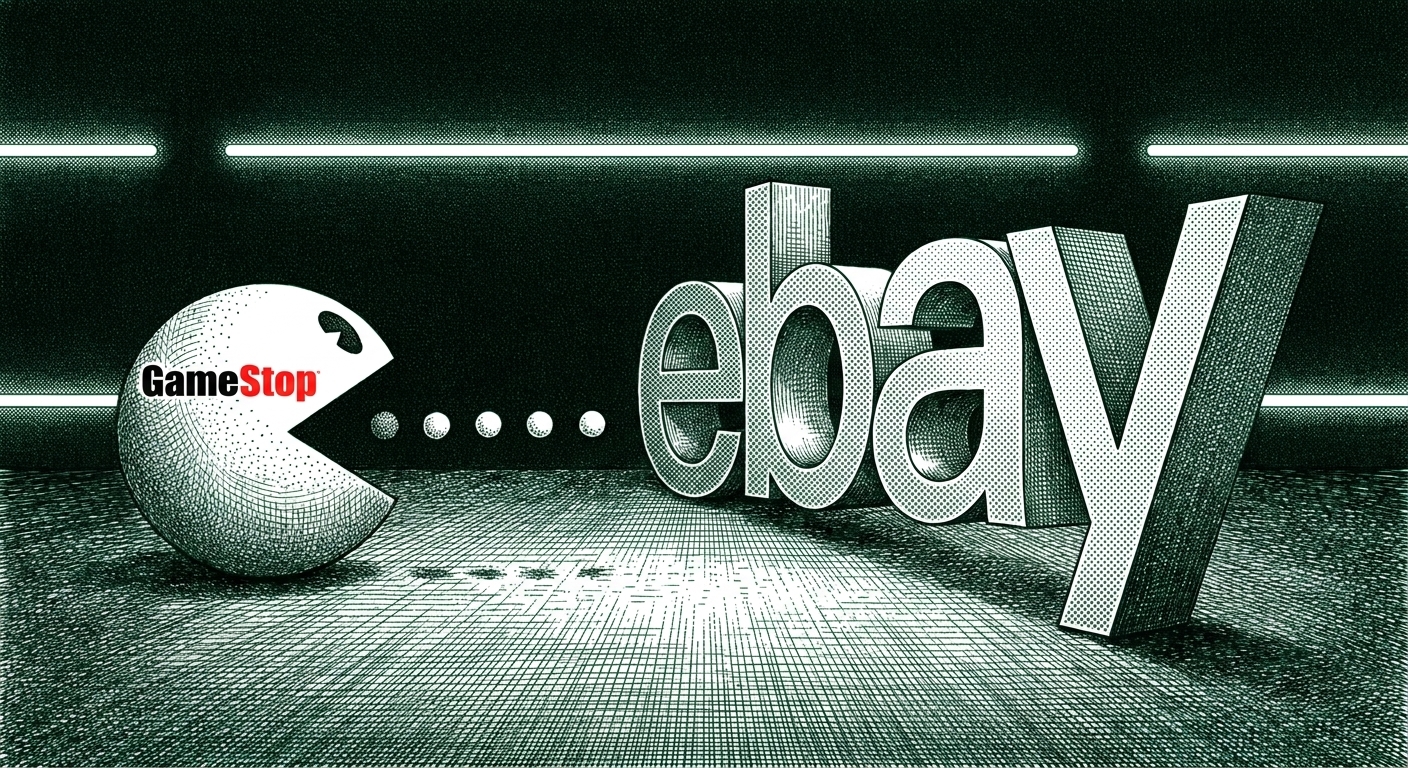
So here’s what happened over the weekend. Ryan Cohen — the activist who turned GameStop from a dying mall retailer into the original meme stock, the patron saint of “to the moon” and “HODL” and the whole 2021 retail-revenge tableau — walked into The Wall Street Journal and announced an unsolicited $56 billion bid for eBay. Cash and stock. $125 a share. The bid is backed by GameStop’s roughly 5% existing stake in eBay, $20 billion of debt-financing committed by TD Bank, $9 billion of cash on the GameStop balance sheet, and the residual halo of a stock that still trades at multiples no fundamental analyst can defend.
The cycle’s first reading is a deal-quality argument. Can a $12 billion retailer leveraged-buyout a $46 billion marketplace. It’s the wrong question. The interesting question isn’t whether the deal happens. The interesting question is what Cohen sees in eBay that the rest of the market doesn’t, and why a meme-era retailer with one of the most loyal retail bases on earth is the vehicle making the bid.
Two artifacts of past consumer hype cycles are colliding here. GameStop is the original meme stock — diamond hands, to the moon, the YOLO archetype. eBay is the original meme commerce — the Pez dispenser origin story, the dot-com fairy tale, Pierre Omidyar built it so his girlfriend could trade Pez dispensers (which turned out to be a charming PR fabrication, but never mind, the legend is the point). Two retail-investor totems, twenty-five years apart, sitting across the table from each other. That alone makes the deal a magazine cover. But the deeper structure is the thing worth writing about.
We’ve been hammering on one thesis for two weeks straight on Signal/Noise and the podcast. Distribution is the moat. Cisco didn’t make the websites of the dot-com era; Cisco shipped the routers that made the websites possible. ARM didn’t make the iPhones; ARM licensed the chip architecture every iPhone runs on. The picks-and-shovels companies in every cycle outperform the rush. We’ve applied that argument so far almost exclusively to the AI labs and platforms — Microsoft, Google, AWS, Musk’s vertically integrated apparatus collecting tribute from the labs riding their rails.
That argument generalizes one rung down the stack, and that’s where the GameStop-eBay deal lives. At the consumer surface, distribution is the asset, the logo is the door, and the customer relationship is the thing nobody can replicate. Most observers haven’t priced this yet because the brands carrying these assets are embarrassing to own. They’re old. They’re broken. They went through a public retail-trader wave and crashed back to earth. They’re the sort of equity that gets called value trap on CNBC and cigar butt on Twitter. Most of them deserve those labels on a standalone basis. None of them deserve those labels as wrappers for the next thesis.
The Trade Saylor Invented
Michael Saylor is the prototype, and the trade he ran in 2020 is now the template every activist with a checkbook is studying.
MicroStrategy in 2020 was a wheezing business intelligence company that had been listed since the dot-com bubble, generated maybe $500 million in revenue, and traded at single-digit multiples because nobody had a thesis on the underlying business. Saylor — the founder, the CEO, the man who’d been at the helm since before the first meme bubble in 1999 — looked at his own balance sheet, looked at where macro was heading, and made a decision that had nothing to do with business intelligence. He started buying Bitcoin. Not as a treasury hedge. As the company. He took the listed shell — the one with the SEC filings, the audited financials, the equity index inclusion, the bond market access — and turned it into a Bitcoin holding company that happened to also sell some BI software.
The math worked because of one thing the underlying BI business couldn’t do: Saylor’s listed equity could absorb capital from places Bitcoin itself couldn’t. Pension funds, mutual funds, indexed strategies, retail brokerage accounts that don’t permit crypto exposure. The shell was the wrapper. The thesis was the content. The shell mattered far more than the BI business it had been wrapped around for thirty years.
By 2024, MicroStrategy had compounded into one of the wildest equity charts in public-market history. Saylor’s personal Bitcoin position — held inside the listed entity — went from a $250 million bet to roughly $40 billion. The BI business is irrelevant to the story. The listed equity wasn’t a software company. It was a vehicle, and the vehicle was the asset.
That trade has now been running long enough that the playbook is generalizing. There are actually two flavors of it, and it’s worth separating them, because the cycle is treating them as the same thing and they aren’t.
Trade A — The Shell Trade. The listed equity itself is the only asset that matters. SEC filings, audited financials, index inclusion, retail-brokerage liquidity, the address book of investors who can hold it. The underlying business doesn’t have to come along; sometimes it gets sold off precisely so it doesn’t. You bolt any new thesis you want on top. Saylor 2020 was Trade A. AllBirds 2026 is Trade A.
Trade B — The Distribution Trade. The listed equity plus intact customer relationships, app installs, email lists, brand recognition, taste graph, payment rails, dispute resolution. Vastly more valuable, because the distribution layer is the bottleneck for AI agents and you can’t recreate it from scratch. Far harder to execute, because the underlying business is still operating and the activist has to either fix it or wrap it. This is what Cohen sees in eBay.
Both trades work. Trade A is louder and faster and the press is already pricing it. Trade B is quieter, slower, and significantly more mispriced.
AllBirds Was The Canary — A Pure Trade A
Look at AllBirds three weeks ago. The shoe company was supposed to be the next Nike — sustainable, wool, Silicon Valley uniform, every tech founder dad walking around in them. Faddish 2021 IPO at $15 a share. Then the business broke. Wholesale fell apart. The retail strategy contradicted the wholesale strategy. CFO out, CEO out, founders out. The equity was trading as if the company was going to zero, and on any standalone basis it should have.
Instead, on April 15, 2026, the operators of the listed shell did something cleaner than a pivot. They sold the entire shoe business — brand, IP, the actual sneaker operation — to American Exchange Group for $39 million, kept the listed entity, announced a rename to NewBird AI, and disclosed a $50 million convertible financing facility to acquire high-performance GPU hardware and lease it out to AI startups under long-term contracts. The shoes were no longer the company. The Nasdaq listing was the company.
The market reaction was immediate and loud. The stock closed up 582% on day one at $14.50, peaked intraday near +600%, and finished the week up roughly 350%. Market cap went from $21.7 million to $159 million before retracing. The press did exactly what the press does when retail traders front-run a thesis they don’t understand. Fortune called it a “desperate AI pivot.” Slate called it “a really bad sign.” Retail Dive used the phrase “AI-washing.” CNBC ran a follow-up warning retail traders that this kind of repositioning “history shows won’t end well.”
The press is missing the point. AllBirds isn’t a pivot. AllBirds is a Saylor. The shoe business was the thing they sold to clean up the shell. What’s left is a public-company wrapper trading on Nasdaq with no operating business, $50 million of fresh financing committed, and a board free to bolt a GPU-as-a-Service thesis onto it. That isn’t a desperate company hoping for an AI bump. That is the cleanest available execution of the listed-shell-as-vehicle trade in public markets right now. Whether NewBird AI succeeds as a GPU lessor is a different question — most won’t — but the trade is the wrapper, not the business inside it, and the market got that part right.
That move — broken consumer brand + clean separation of the shell + AI thesis bolted on → equity repricing — is going to repeat. The activist money knows. The hedge funds running the screen know. The CEOs of the busted brands know it, which is why every one of them is rapidly looking for some version of the move. Most won’t survive the second-derivative test. But the cleanest ones will look obvious in retrospect and compound the way MicroStrategy did.
Trade A is now visible to retail. Which means Trade A is approximately fully priced. The interesting trade is the next one over.
eBay Is The Perfect Trade B, And The Tell Is Sitting In My Account
eBay is the cleanest distribution-trade case in the entire market, and the GameStop bid is making it visible.
The financial profile is what you’d expect for a Trade B candidate: a real cash-generating business with stalled top-line excitement and a market that long ago stopped paying attention. Full-year 2025 revenue was $11.1 billion, up 8%. GMV was $79.6 billion, up 7%. Q4 GMV grew 10%, with revenue up 15% — the marketplace is reaccelerating, not flatlining the way the lazy sell-side narrative has had it. Free cash flow was $1.5 billion in 2025 (down from $1.96B in 2024 — meaningful, but still a 13.5% FCF margin). Operating cash flow was $2.0 billion. And the company returned over $3 billion to shareholders during the year — $2.5 billion in buybacks, $531 million in dividends, with the Q1 2026 dividend just bumped 7% to $0.31 and a fresh $2 billion buyback authorization layered on. This is not a husk in the AllBirds sense. It’s a profitable, capital-returning business that the market priced as boring.
But here is what eBay actually is, on its own customer-relationship balance sheet. 135 million active buyers — up only 0.7% year-over-year, which is exactly the point: the buyer base is flat because the company stopped trying to wake it up. Direct relationships, not affiliated through Amazon or Google. Authenticated accounts with shipping addresses, credit cards on file, twenty years of purchase history. An app installed on hundreds of millions of phones, including phones whose owners haven’t opened it in two years but who would absolutely log back in for the right reason. An email list with permission. A checkout flow consumers already trust. A reputation system that took twenty-five years to bootstrap and that nobody is going to recreate. A taste graph richer than what almost any pure-play AI company is sitting on.
And here is the part the cycle hasn’t priced. Recommerce is now over 40% of eBay’s GMV, with focus categories — Collectibles, Parts & Accessories, Fashion — growing 12%+ in 2025. That is exactly the AI-agent-friendly inventory. Authentication, valuation, taste-graph matching, vintage and rare-item sourcing, persistent-watcher logic across long-tail listings, provenance verification — every one of those is a place where a competent agent adds enormous value, and every one of them is structurally where eBay’s marketplace is differentiated from Amazon. Recommerce is the part of e-commerce where AI matters the most because every listing is unique, every authentication question is non-trivial, and every buyer’s taste graph is the actual entry point. eBay is structurally pre-positioned to be the marketplace agents reach for when they need pre-loved, refurbished, or collectible inventory — which is going to be a much bigger share of agentic spend than the cycle is currently pricing.
I’ll make this concrete. My personal eBay account knows things about me that almost nothing else online knows in the same combination. It knows I have a Sonos system because I bought replacement amplifiers there when the originals failed. It knows I went deep on tiki ephemera during the COVID lockdown — pile after pile of vintage mugs, an entire shelf of Otagiri and Trader Vic’s-era pieces, the kind of long-tail collecting that simply doesn’t exist on Amazon and that produces profile data that looks nothing like a generic shopper. It knows I’ve spent meaningful time browsing vintage watches without ever pulling the trigger — which is arguably the most valuable signal any platform can have on a customer, the high-intent un-converted browse, the question that hasn’t quite become a yes.
And what has eBay done with any of this? Absolutely nothing. The product I see when I open the app is the same product everyone else sees. The recommendations are the most generic possible inference from my last few searches. The email I get is “items you watched are now ending soon.” There is no agent on the platform that watches the entire global supply of Sonos amplifier replacements and surfaces the right one when another of mine inevitably fails. There is no agent that watches eBay for new mugs from my favorite makers — Tiki Diablo, Tiki Tony — and pings me when their drops hit the marketplace, hours before the rest of the collector community sees them. There is no agent that pings me the moment a Trader Vic’s NYC Plaza Hotel-era menu gets listed, after years of me showing exactly that interest pattern. There is no agent that has been running on the vintage-watch problem for two years, building a profile of which references I’ve looked at, which sellers I trust, what provenance I require, what authentication standard I want — and presenting me with the one listing in a thousand that would actually convert. The high-intent un-converted browse is the most expensive signal in commerce. eBay has been collecting it on me for fifteen years and has done nothing with it.
That entire surface — that entire agentic concierge layer — is sitting on top of eBay’s existing customer relationships, waiting to be built. And the cost to build it from scratch, today, in 2026, is preposterous. You’d need the customer relationships, which take twenty-five years and $40 billion of brand spend to bootstrap. You’d need the trust layer, which takes another twenty-five years of dispute resolution and reputation systems. You’d need the inventory side, which requires twenty million sellers. You’d need the payment rails, the shipping integrations, the tax-and-VAT compliance. A new entrant can’t. A new entrant looks at the wall and goes home.
eBay can. It just isn’t. That gap — the gap between what eBay’s distribution can support and what eBay’s product team is actually doing — is the entire investment case. It’s the gap Cohen and his backers are betting on.
Who Else Has The Husk — Look At Your Phone
Forget the financial screens for a minute. The fastest way to find the candidate list isn’t a Bloomberg terminal. It’s the phone in your pocket.
Open the app library. Scroll to the folder of apps you don’t use anymore but haven’t deleted. The ones iOS has quietly offloaded to save storage. The ones with your credit card on file, your email captured, your shipping address stored, sitting dormant. Every one of those apps is a brand whose company has a direct consumer relationship with you, has years of behavioral data on you, and is doing nothing with any of it. That folder is the candidate list. It’s not theoretical. The activist allocators are running this screen — they just have $500 million budgets and you have a phone.
I just looked at mine for thirty seconds. Etsy. Marketplace, my account, my saved searches, my cards on file, browsed for hand-thrown ceramics during the same tiki window I was hitting eBay. Haven’t opened in months. Yahoo. Mail, Finance, the residual brand recognition that survived three corporate parents. Headspace. Subscription history, meditation streaks, sleep data, profile information about a phase of my life I went through and walked away from. Noom. Weight, eating logs, photos of meals, the entire embarrassing corpus of a lifestyle product whose underlying business model just got vaporized by GLP-1s. Each of those companies has data on me that’s worth real money to whoever figures out how to wake it up. None of them are doing it. That’s the screen.
Now let me walk you through one public-equity candidate that passes the same test cleanly:
Peloton. Broken business. Equity decimated from the post-pandemic fade. Multiple CEO rotations. But what’s still there is a trusted health-hardware brand, sitting in millions of homes, with a connected user base that already tolerates monthly subscription billing — and that’s a far rarer asset than the cycle is pricing. The mystery is what Peloton hasn’t done with it. They’re not in the electrolyte business. They’re not in the supplements business. They’re not running a serious nutrition or recovery line. They let Whoop — a strapless wristband with a tenth of Peloton’s brand recognition and zero hardware footprint in the home — get to a $5 billion private valuation on the exact thesis that should be Peloton’s: trusted health hardware as the entry point for the all-in tracking and consumables stack. Peloton already integrates with Apple Watch. They could integrate better, on the metrics their consumers actually care about, with their own products front and center, and turn the install base into the most defensible health-and-longevity flywheel in consumer. They don’t. The bike is the rail. The brand is the door. Somebody is going to walk through it.
The general rule of the screen is direct consumer relationship + intact distribution + dormant data asset. Anything that fails one of those three columns is junk. Everything that passes all three is on the watchlist of every activist allocator with $500 million to deploy and a CEO friend willing to take the chairman seat. Or sitting in the offloaded-apps folder on your iPhone.
Why This Trade Works In 2026 Specifically
The reason this trade works now — and didn’t work in 2021 or 2018 or 2014 even though every one of these brands existed in some moribund form back then — is that AI has finally crossed a specific capability threshold. Not the AGI threshold the labs keep pointing at. A different one. The threshold where the relationship between a company and its customer can flip from one-to-many to one-to-one without the company having to build a single new system.
For thirty years of consumer software, the model has been one-to-many. The company builds a product. The product is the same for every customer. Personalization, where it exists, is a thin layer on top — a recommendation algorithm that compares your behavior to the cohort’s, an email cadence triggered by lifecycle stage, an “items you might like” carousel that everyone sees a slightly different version of. The customer is, structurally, one of many. The product is built once, broadcast to all, and the platform optimizes the average.
AI breaks the average. Every customer can now have an agent that knows them specifically, mines the platform’s inventory on their specific behalf, learns their specific taste, and does the work of a relationship that was previously impossible to scale. Not a slightly better recommendation. A different relationship entirely. The platform stops being a product the customer visits and becomes a service that operates in the background on the customer’s behalf. The customer doesn’t have to log in. The customer doesn’t have to remember they have an account. The agent does. The husk wakes up because the agent walks through the door the husk built and starts using rooms the company never finished decorating.
Three technical preconditions just became simultaneously true. The model layer is commoditizing — as we wrote last week, you can now run a competent autonomous agent on DeepSeek V4 Pro for one-seventeenth the cost of running it on Claude. The personalization agent is no longer the bottleneck; the distribution it gets bolted onto is. Agentic spending is real — Stripe’s Sessions architecture means agents can transact autonomously with single-use credentials, and every major rail is converging on it. The platform with the existing checkout relationship is the platform that gets the agent’s money. And trust is now the binding constraint — Anthropic crossed $1 trillion this week on a safety pitch, the Five Eyes services told enterprises to keep agents on a short leash, the brand-and-customer-relationship layer becomes the trust substrate for the agentic economy. Stack the three. Cheap models. Open rails. Scarce trust. The trust is sitting in the husks.
Look at TripAdvisor. Two hundred million-plus members. Decades of reviews, photos, hotel ratings, restaurant rankings, attraction bookings, trip itineraries from every consumer who ever planned a vacation on the platform. The company knows where I went, where I stayed, what I rated four stars and what I rated two, what neighborhoods I gravitated toward, what kind of restaurant I bothered to leave a review for and what kind I didn’t. Why isn’t TripAdvisor a personalized travel agent for every account it has? It kind-of-sort-of is — there’s a “trips” feature, there are AI-suggested itineraries — but it isn’t all the way, and it isn’t deployed to every consumer in the database. The capability is finally cheap enough that it should be. The trust to spend my money on a hotel booking is sitting in the brand. The data is in the database. The customer is on the email list. The bottleneck — the only bottleneck — was the cost and capability of the agent. That’s not a bottleneck anymore.
Disclosure: I sit on the board of Weedmaps, ticker MAPS. The company recently delisted from Nasdaq, currently trades on the OTC market at less than 1x sales, and it’s exactly the case that taught me to think about this problem the way I do. Weedmaps has direct relationships with a meaningful subset of cannabis consumers in the U.S. — the kind of relationship that’s hard to build and harder to replicate, in a category that has structural reasons for relatively little organized competition. Why can’t MAPS be the personalized cannabis concierge for every consumer it already has — knowing the strains they prefer, the dispensaries they trust, the terpene profiles they actually like, the new drops they’d want flagged, the price arbitrage they’re missing across menus they’re already legally allowed to browse — instead of a directory people open when they remember it exists? I’m not making a stock call from a board seat, and I’m certainly not questioning management. I’m describing the category logic.
It’s the same logic running through every consumer-relationship husk in the public market right now. If you are reading this, chances are you can identify a few of these off the top of your head. The trades are sitting in plain sight.
The Screen, And Who’s Next
Walk every consumer-facing equity trading at less than 1x revenue through three questions. Does it have a direct consumer relationship — an account, an app, a customer service relationship that isn’t intermediated by Amazon or Google? Does it have at least five years of behavioral or transactional data on those customers? Is the management team, or an activist, in a position to authorize a strategic repositioning? If the answer to all three is yes, the equity is on the watchlist. Most of the names on that watchlist would be embarrassing to own at a fundraising dinner. That’s the whole point of the trade. The discount is the embarrassment.
Who’s next? Walk down your old watchlist with this screen. Open the offloaded folder on your iPhone. The candidate list is sitting in plain sight. The activists already ran it. The press releases are coming.
— Harry
This piece develops the thesis we’ve been building on Signal/Noise and the CO/AI podcast over the last two weeks: distribution is the moat, the labs are the miners, and the platforms — and now the husks — are the picks-and-shovels trade. Tell us which husk we missed.
More like this
Palantir’s Alex Karp Just Called the AI Industry “Effing Insane” Here’s What He’s Really Selling You
Alex Karp Just Told You Not To Trust Your AI Vendor. He’s Also Selling You the Fix. Palantir’s...

Schools Chose AI Detection Over AI Fluency. Now Your Kid Is on Your Clock.
More than half of America’s K-12 teachers cannot tell you what their school’s policy on AI is. Not...

Which Job Gets Its 1000X Next
Somewhere out there is a developer shipping in a week what used to eat a team for a...