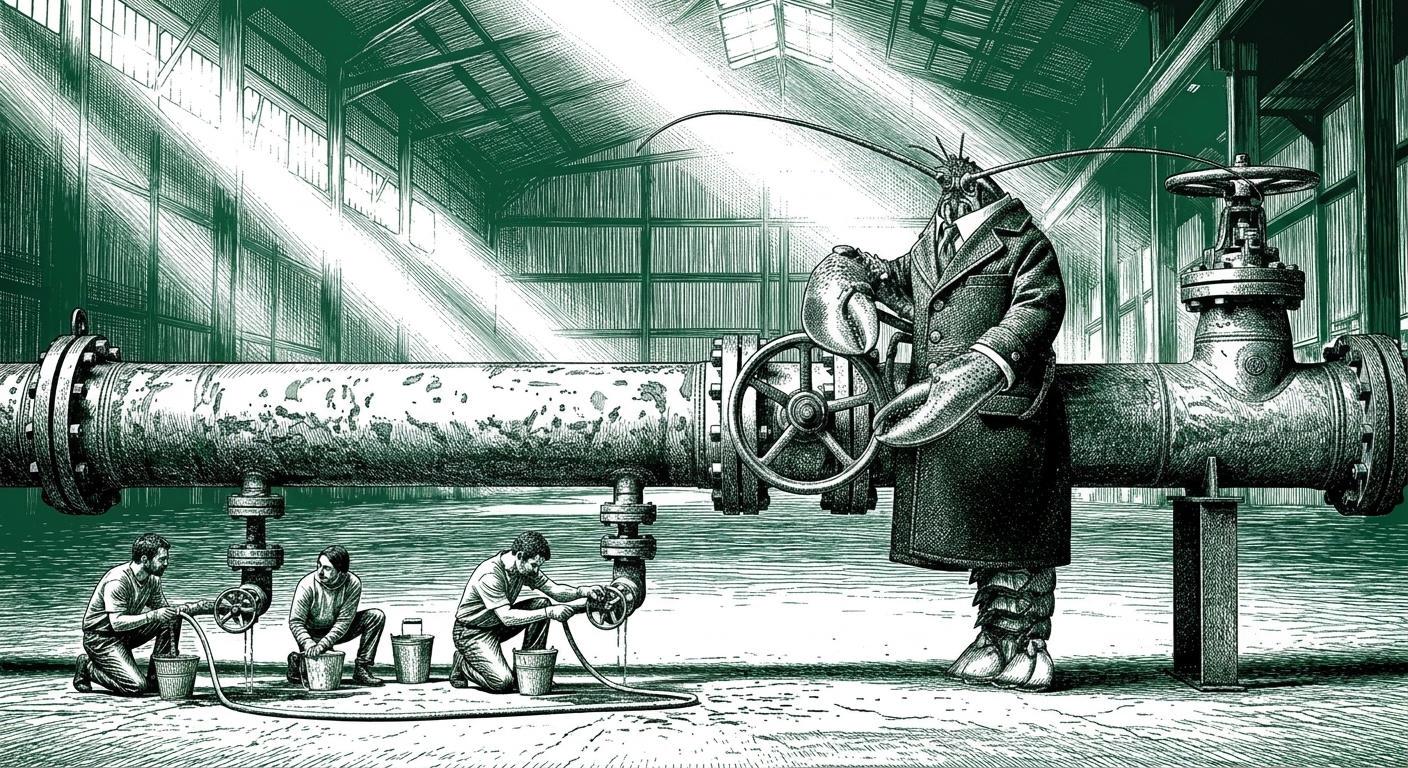
OH SNAP! Spiegel Said the Quiet Part Out Loud: Distribution Is The Only Moat Left
Snap's CEO told Lenny on Sunday morning what your VC has been pretending isn't true since 2021. Capital is commoditized. Pattern recognition is post-hoc. The only thing that compounds through the AI fog is whoever already owns the pipe.
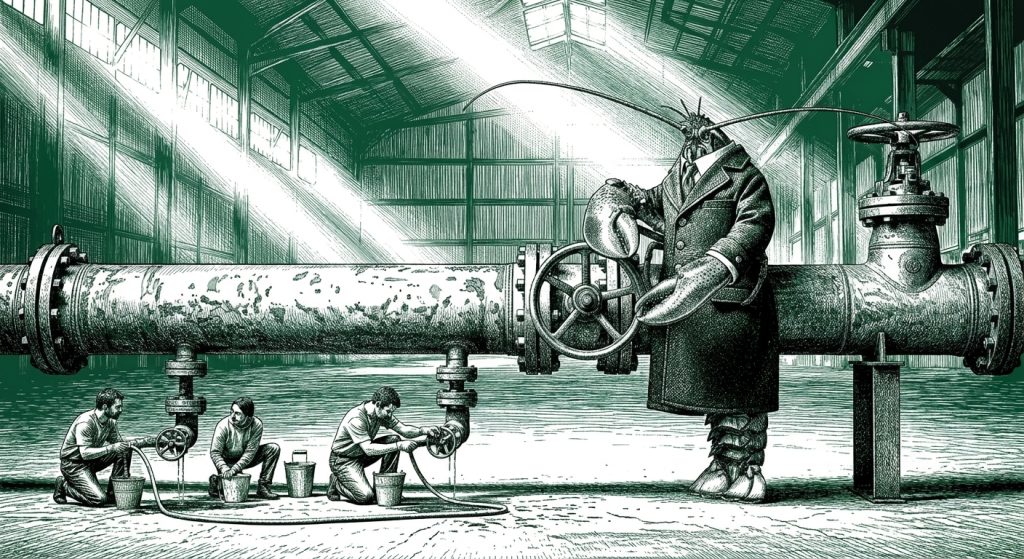
THE NUMBER: 2 — the number of consumer apps Evan Spiegel says broke through in the last fifteen years. Two. In a decade and a half of unprecedented venture funding, frontier-model handouts, three trillion dollars of M&A, free distribution surfaces, and the largest concentration of engineering talent in human history. Snap was one of them. Spiegel just told Lenny Rachitsky on Sunday morning that every meaningful feature his company invented — Stories, swipe-based navigation, camera-first UX, AR lenses, Specs — was cloned within twelve months by a competitor with bigger distribution. Software, he said, isn’t a moat anymore. Hardware is. Distribution is. Everything else is a feature waiting to get copied. We’ve been writing five issues a week to that exact conclusion for the past two weeks. On Sunday morning the CEO of a public consumer tech company sat across a microphone and confirmed it. Pay attention.
We’ve spent the last two weeks running a single argument across five issues. Warp Speed was about how fast everything is moving. The Nail Factory was about what breaks when you automate without rebuilding the measurement layer. Mind The Gap was about who gets to be wrong for longer. Back In the Game was about Elon writing the largest call option in M&A history to lock down compute capacity. Brutalist was about Google paying Apple twenty-six billion dollars a year to keep the iPhone as a search distribution channel. And on Friday, GPT-5.5 Released. Brooklyn Tiki Bar Reports Normal Operations. was the one where we admitted the whole AI commentary apparatus might be TMZ for nerds. Each was the same argument in different costumes. Every layer of the AI stack is being commoditized except the one that already won — the layer that puts a product in front of a billion people on Tuesday.
Three things landed this weekend that finished the argument for us. Evan Spiegel went on Lenny’s podcast and said it explicitly: distribution is the most important moat in consumer technology, full stop. Tomasz Tunguz at Theory Ventures published a piece using Joel Spolsky’s old “commoditize your complement” framework to map what Anthropic is doing right now — and the diagram makes it look exactly like Google in 2003. And Marcus Schuler at Implicator caught the cleanest tell yet that the labs already know the game has moved: OpenAI shipped GPT-5.5 inside ChatGPT and Codex on Thursday and quietly delayed the API. The model race left the leaderboard. It’s been moved into a hallway with a velvet rope.
The implication for an allocator is uncomfortable and we’ll say it before the stories: most of what your venture money is buying right now is a credential, not a competitive advantage. The funds that built actual distribution apparatus a decade ago — the ones that look more like media companies than hedge funds — are about to look like the only honest game in town. The rest are running out the clock on their last vintage. The pitch was always the Rolodex. The thing that delivers in 2026 is the agency that connects portfolio companies to a million-person audience on a predictable schedule. Those are different products. Most LPs are still paying for the first one and assuming they’re getting the second.
📉 Snap’s CEO Just Confirmed What Every Pitch Deck Has Been Pretending Isn’t True
Spiegel sat with Lenny Rachitsky and named the thing publicly. Only two consumer apps have broken through in fifteen years. Every major feature Snap invented got copied by a bigger competitor inside a year. Stories went to Instagram in 2016 — Spiegel told the story of Mark Zuckerberg calling him about it personally, the way you’d warn a cousin you were about to take their parking spot. Snap shipped Pixy, the camera drone. Got copied. Snap pioneered the camera-first interface, swipe-based navigation, AR lenses with face tracking. All of it cloned. The only thing the clones can’t replicate, in his telling, is the distribution layer underneath the product. And the distribution layer in consumer is now hardware-shaped, which is why Snap is betting Specs is the franchise that has to work.
Spiegel’s number — two consumer breakthroughs in fifteen years — is the part to sit with. That’s the period that produced the largest pool of engineering talent and venture capital in history. SaaS multiples were rewriting financial textbooks. Founders had unlimited access to free cloud credits, free model APIs, and an entire industry telling them software was the highest-margin business ever invented. And in that environment, two products broke through. Snap was one. The other, presumably, is TikTok — and the moat there isn’t the algorithm everyone fetishizes. It’s that ByteDance has eight billion daily active users across its property portfolio, which is more distribution than any consumer app has ever had. The algorithm wins because it sits on top of a pipe nobody else owns.
The intellectual honesty in Spiegel’s framing is what separates it from the average founder podcast. He didn’t claim Snap built a better product. He claimed Snap built distribution Meta couldn’t fully copy — a teen graph, a closed-loop chat behavior, a hardware ambition that hasn’t paid off yet but is the only durable moat he can see. And he said the part most CEOs of consumer companies are too embarrassed to say: a pure software business is no longer a defensible business. The cost of replicating any single feature has collapsed. The cost of replicating distribution has not.
Why this matters: If you’re building a consumer product in 2026 and your moat is software taste, you don’t have a moat. You have a feature. The first time it works, your three biggest competitors ship it as an update inside an existing app with a hundred million more users than you have. Spiegel’s framing should be the first slide in every consumer-tech pitch deck this quarter. The conversation to have with your team this week: what about us is distribution-shaped, not feature-shaped? If the honest answer is nothing, you have a positioning problem masquerading as a product problem.
💲 Tunguz Just Drew the Diagram We Couldn’t Stop Thinking About
Tomasz Tunguz at Theory Ventures published a piece on Friday that does the analytical work the rest of the AI commentariat keeps avoiding. He took Joel Spolsky’s twenty-three-year-old framework — commoditize your complement — and laid it side-by-side over Google’s 2003-2008 product lineup and Anthropic’s 2024-2026 product lineup. The two tables look identical. Different decade, same playbook.
Google’s complements were free maps, free Gmail, free Chrome, free Android. None of those products were the business. Search advertising was the business. Maps existed to capture local-search intent. Gmail existed so Hotmail couldn’t gate-keep your inbox. Android existed so Apple and Microsoft couldn’t block search on the phone you bought. Chrome existed to make the web faster, because a faster web meant more queries. Each free product was a strategic move to keep the toll booth open between the user and the Google search bar. It worked. The next decade and a half was Google compounding on top of every browser, phone, inbox, and map in the world.
Tunguz’s parallel to Anthropic is brutal in its precision. MCP launched November 2024 as an open standard for AI-to-data connections — that’s the email-and-maps move, killing walled-garden lock-in before any competitor could build it. Claude Code Security ate the AppSec category in February. Claude Cowork ate the file-and-task orchestration layer. Claude Design ate UI/UX. Interactive Apps ate the productivity suite, embedding Slack, Figma, and Asana inside Claude itself. Each launch is a free or near-free complement to Anthropic’s actual business, which is the model. More usage across more workflows means more data, which makes the model smarter. Same flywheel Google ran for fifteen years. Different decade. Identical structure.
What Spolsky’s framework lets you predict is which application categories are about to get rolled. It’s not the categories that compete with Anthropic’s model. It’s the categories where Anthropic’s free or near-free version is good enough to break the existing pricing model. AppSec didn’t get killed because Claude Code Security is best-in-class. It got killed because it’s free, integrated, and good enough. Same play Google ran on the GPS hardware industry — Garmin didn’t get killed because Google Maps was better at routing. It got killed because Google Maps was free.
Figma’s stock dropped 14% in three trading days when Claude Design shipped, and Figma was paying Anthropic for compute the entire time. We covered the irony in Mind The Gap. Tunguz’s piece supplies the framework for what comes next. Asana is at risk. So is every standalone copywriting tool. So is Notion, possibly Slack itself, possibly Salesforce’s middle-tier products. The lab isn’t competing on quality. It’s competing on price compression to drive usage of its actual product. That’s a structural attack the SaaS playbook has no answer for.
Here’s what to do: Bezos used to walk into rooms and tell SaaS CEOs “your margin is my opportunity.” That was the AWS playbook for fifteen years. The labs are running the same line on application software in 2026 — except instead of competing on price, they’re shipping a free version to drive usage of the model underneath. If your product sits in a category where Anthropic, OpenAI, or Google could ship a free or sub-cost version in eight quarters, you don’t have a SaaS business — you have a category waiting to get commoditized. The conversation to have with your board this quarter: which of our products would still have demand if a frontier lab shipped a free version next week? The ones that survive that test are your actual business. The ones that don’t are the part of the company you should be spinning down or pivoting now, while you still have the cash to do it gracefully.
🔒 OpenAI Locked the API. Access Just Became the Product.
OpenAI shipped GPT-5.5 on Thursday inside ChatGPT and Codex. The benchmarks read like a victory lap — 82.7% on Terminal-Bench 2.0, 78.7% on OSWorld-Verified, 84.4% on BrowseComp, all marketed as a frontier win over Opus 4.7. The slides told a tidy story.
The release calendar told a different one. Marcus Schuler at Implicator caught the tell on Friday: the model went wide where OpenAI controls the surface — paid ChatGPT, Codex, Pro, Enterprise, Business — and stayed locked behind a delay where third-party builders could wire it into their own products. The API rollout, the company said, “follows later.” The line in the press release was that API deployments need different safeguards. The line in the system card was more honest: UK AISI found a universal jailbreak of GPT-5.5’s cyber safeguards during pre-release testing. The wide rollout means OpenAI thinks the wrapper is strong enough — not that the model is.
This is the same play Anthropic ran on Mythos two weeks ago. Frontier capability shipped behind a forty-organization whitelist. The model the company itself called too dangerous to release publicly. Then Bloomberg reported the whitelist had been bypassed and a private Discord had access while CISA didn’t, and the whole “managing a weapon” narrative we wrote about in Warp Speed, Fast and Slow collapsed inside a week. Both labs are now doing the same thing for slightly different reasons. The model race left the leaderboard. The product race is now about who controls the door.
The pricing makes the strategy explicit. GPT-5.5 list price doubled to $5 per million input tokens and $30 per million output, against $2.50 and $15 on GPT-5.4. Artificial Analysis confirmed the model uses about 40% fewer output tokens to finish a task, so the real-world bill rises closer to 20%. That math only works for OpenAI inside their own surfaces, where they can package the higher price as a quality bump. It’s much harder to defend in the API where the customer can run a finished-job comparison against Opus 4.7 (which beats GPT-5.5 by fifty points on the AA-Omniscience hallucination benchmark) or against DeepSeek V4, which shipped Friday on Huawei silicon at one-eighth the output price and runs on consumer-grade hardware.
There’s a simpler way to read all of this. The labs already know what Spiegel just said publicly. Frontier capability is no longer a moat. Distribution is. So the move is to keep the model where it can be packaged with the surface — and keep it out of the hands of competitors who would use it to compete on something other than distribution. Cursor figured this out in March, which is why Elon’s SpaceX call option on Cursor at $60 billion makes structural sense. Cognition is the last independent coding lab of size, and Bloomberg reports they’re raising at $25 billion — a 2.5x markup in seven months on the bet that scarcity pricing on the last surviving independent will hold. None of this is about whether the models are good. It’s about who owns the access layer between the model and the customer.
Connect the dots: Whoever controls the access surface owns the pricing power. The benchmarks become marketing. The model becomes a feature inside a wrapper. And if you’re an enterprise buyer in 2026, the procurement question isn’t which model is best. It’s which surface is going to be there in three years, which surface gives me real cost visibility, and which one of these vendors is going to compete with me directly inside the same surface eighteen months from now. If you can’t answer those, you’re underwriting somebody else’s distribution strategy with your own budget.
🦞 The Part Nobody Talks About: Distribution Is Operational
Here’s the piece of the argument that gets buried under the takes. Spend any real time inside the venture business and you learn that the Rolodex pitch is almost universal. Our LPs back us because we have a network nobody else has access to. We can open doors for our portfolio companies that capital alone can’t open. That pitch wasn’t wrong. For three decades, the size and quality of a top-tier VC’s Rolodex was a real, durable moat. Don Valentine’s phone on speed dial was the actual Sequoia product in 1985 — the capital was almost incidental. Kleiner Perkins ran the Valley for fifteen years on the same model. The Rolodex was the franchise.
What changed is what founders need.
The Rolodex was always great at one thing: getting a particular call returned by a particular person. I can get you a meeting with the CTO of Walmart. That’s a real favor and it still works for one-time door-opening. What it has never scaled to do — and what the 2026 founder actually needs — is I can get your product in front of 100,000 people on Tuesday morning, and again next Tuesday, and the Tuesday after that. The first is a relationship. The second is a media apparatus. They are different products built on different infrastructure. The difference between them is the one fact most LPs aren’t pricing yet: capital plus relationships was the 1990s product. The market evolved into wanting capital plus a productized distribution machine. Most firms didn’t make the operational investment ten years ago to build the second one, which is the structural reason a lot of 2018-2021 vintage funds are quietly running out the clock on their last vintage right now.
The pattern wasn’t invented by a16z, and it’s worth saying that out loud because the history changes how you should read what’s happening now. Look at who dominated venture conversations from roughly 2008 through 2016 and you’ll find three names: Fred Wilson at Union Square Ventures, Paul Graham at Y Combinator, and Mark Suster at Upfront Ventures. Different funds. Different theses. Same actual product. They were the most prolific, most thoughtful bloggers in Silicon Valley, and AVC, pg’s essays, and Both Sides of the Table were the original distribution-VC operations. One-person media franchises, built on free platforms — Tumblr, the open web, eventually Substack — that made their firms famous and made the partners into industry stars years before “thought leadership” became a corporate-comms category. If you were pitching in 2012, you didn’t want Fred Wilson’s term sheet because USV’s IRR was best-in-class. You wanted Fred’s attention, because an AVC post about your company meant every founder, journalist, and LP in the social-media era was going to read about it within hours. That was the signal and the distribution, all in one.
YC’s headline in those years was the acceptance rate lower than Caltech’s. But if you were a 22-year-old applying in 2014, the actual prize wasn’t the SAFE check or even the famously Oxford-tutorial-style office hours with the professors. It was that getting in put you inside the gravitational pull of pg — one of the most thoughtful and most-read writers in Silicon Valley, whose essays are still being quoted in YC pitch decks ten years later. The credential and the distribution layer were welded together. The Oxford office hours mattered. The pg coverage mattered more.
a16z is the firm that took that one-person media model and industrialized it. The right way to read Marc Andreessen’s last decade isn’t that he’s an unusually loud venture capitalist — he’s the one who decided ten years ago that the Fred-and-pg playbook had to be turned into a hundred-plus-person operation. The output: a podcast network, the Future content arm, full-time content engines on X, an operations team that helps portfolio companies hire, a go-to-market team that places founders in front of enterprise buyers, a talent team, a policy and government affairs team, a media relations team, an events team. The fee structure looks more like a media company’s than a fund’s. Because functionally, that’s what it is. The part most LPs don’t notice is that the vertical splits Andreessen has been rolling out — Games, Crypto, American Dynamism, Bio — are a hedge against a future where the generalist brand stops mattering and the specific vertical distribution apparatus does. He sees consumer-tech-style distribution being redrawn lane by lane. He’s positioning for it.
The harder question — and the one nobody in venture wants to answer publicly — is what happens to the founder-celebrity model when every VC has a podcast, every senior partner has a Substack, every X account has a content team behind it, and the platforms that made AVC famous have commoditized attention to the point that one extraordinary writer in 2012 is competing against fifty well-organized media operations in 2026. The credential is still real. Fred is still posting. pg is still being quoted. But the distribution layer underneath the credential — the thing that actually got the meeting taken, the round oversubscribed, the founder famous — is now operating at a scale that the one-person-blog model can’t match. That’s the part the next decade is going to test, and the firms that don’t pass the test won’t disappear loudly. They’ll just slowly become museum pieces, like Kleiner.
The forward-looking bet that follows from all of this isn’t subtle. The biggest open opportunity in 2026 is consumer tech, if somebody can finally cobble together the right distribution stack. The components exist. A creator with an audience — pick from MrBeast, Joe Rogan, Andrew Huberman, Lex Fridman, Patrick Mahomes, Alex Cooper. A platform surface holder — TikTok US, YouTube, Instagram, Apple, Meta, ByteDance. An operational apparatus to connect portfolio companies to the surfaces — the a16z-style layer most firms don’t have. A relatively small amount of capital. The first firm or family office to assemble all four for consumer is going to own that lane for a decade. Larry Ellison’s combined position — Oracle, the Paramount-Warner content library, and the TikTok US stake — is the most extreme version of this gap that’s currently unweaponized. He’s eighty-one. Watch that space.
The action item: If you allocate capital — whether from a fund, a family office, or a personal portfolio — the diligence question for 2026 isn’t what’s your AI thesis? It’s what’s your distribution surface, and what’s the operational apparatus that connects your portfolio companies to it? If the answer is a community manager and a once-a-year founder summit, you’re funding a 1990s product. If the answer is podcast network plus operating team plus vertical specialization plus enterprise GTM motion, you’re funding a 2026 product. The difference shows up in the next decade’s returns. Pick accordingly.
What This Means For You
The argument we’ve been running for two weeks just got confirmed by Snap’s CEO on a Sunday morning podcast. Capital is commoditized. Pattern recognition is post-hoc. Software is no longer a moat. The only thing that compounds through the AI fog is whoever already owns the pipe. The labs know it — that’s why OpenAI locked the API and Anthropic is running Google’s 2003 playbook. The funds that built operating apparatus a decade ago know it — that’s why a16z looks more like a media company than a hedge fund. The ones that didn’t are running out the clock.
Audit your moat this week. If your product’s defensibility is taste, speed, or feature breadth, you’re competing in a category that gets commoditized in the next eight quarters. Defensibility lives in regulated workflows, customer relationships measured in decades, proprietary data nobody can license, physical-world handoffs, and distribution surfaces. Anything else is rentable.
Stop confusing credentials with capabilities. A YC badge or a Sequoia logo on your slide is a 2015 product. The 2026 question your LPs and your buyers are starting to ask is what gets activated on your behalf. Pick advisors, investors, and partners on what they can deliver, not on whose name carries weight in a deck.
If you’re allocating capital, own the surface directly. The cleanest play in 2026 might not be allocating to AI VCs at all. It might be holding the public-market vehicles that own the distribution surfaces — Google, Apple, Meta, and whatever wraps Larry Ellison’s stack eventually. You can’t outsource distribution to a fund manager. You have to own the pipe.
The window is open in consumer tech. Nobody has assembled creator + platform + operational apparatus + capital into a single distribution-VC vehicle yet. The first person to do it will own consumer tech for a decade. The components are sitting there, mostly under-monetized, waiting for somebody with the operational chops to combine them. If we were thirty-five and starting over, that’s where we’d put our energy.
Three Questions We Think You Should Be Asking Yourself
What about your business is distribution-shaped, not feature-shaped? Spiegel just told Lenny that every meaningful Snap feature got cloned inside twelve months. Your product is in the same situation. Run the exercise honestly: which parts of what you built can a competitor with bigger distribution copy in a year, and which parts are anchored to a pipe they can’t replicate? If the second list is empty, you’re a feature waiting to get commoditized.
Which lab is silently running the Spolsky play on your category? Tunguz mapped Anthropic onto Google’s 2003 playbook. The lesson is that you don’t get killed by a competitor that’s better than you. You get killed by a free or sub-cost version shipped by the company whose actual business is one layer up the stack. Look at your category and ask: which complement to a frontier model are we, and how long until the model ships a version of us inside its own product?
If you’re an LP, what’s the actual operational apparatus your VC firm activates on behalf of portfolio companies? Not the pitch. The actual machine. A community manager and an annual summit is not a distribution apparatus. A podcast network with millions of subscribers, a placement team that lands founders inside enterprise buyers, and a vertical specialization that compounds — that is. Most firms have the first. Very few have the second. The difference shows up in returns over the next decade.
A pure software business is no longer a moat. Hardware is. Distribution is. Everything else is a feature waiting to get copied.”
— Evan Spiegel, Lenny’s Podcast, April 26, 2026
The interesting part isn’t that he said it. It’s that he said it on a public podcast hosted by the most-read product newsletter in tech, three days after Anthropic ran the Spolsky play on Figma’s category and four days after OpenAI locked GPT-5.5 behind its own surface. Three data points. One conclusion. The CEOs already know. The pitch decks haven’t caught up yet.
— Harry and Anthony
Sources
- Snapchat CEO: Why distribution has become the most important moat | Evan Spiegel — Lenny’s Newsletter
- Competitive Strategy in the Age of AI — Tomasz Tunguz, Theory Ventures
- OpenAI Locked The Door. DeepSeek Undercut The Price. — Implicator.ai (Marcus Schuler)
- Adobe Summit 2026 — The AI Report (Liam Lawson)
- Strategy Letter V — Joel Spolsky (the original “commoditize your complement” essay)
- Figma’s woes compound with Claude Design — Martin Alderson
- Cursor Hits $2.7B Annualized Revenue and $900M Loss As SpaceX Readies $60B Takeover — The Information
- GPT-5.5 by the Numbers — Implicator.ai
- DeepSeek V4 Pro and Flash Undercut OpenAI Pricing by Up to 10x — Implicator.ai
- Cognition raising at $25B valuation — Bloomberg via Implicator
- CO/AI Signal/Noise — Brutalist (April 23, 2026)
- CO/AI Signal/Noise — Back In the Game (April 22, 2026)
- CO/AI Signal/Noise — Mind The Gap (April 20, 2026)
- CO/AI Signal/Noise — The Nail Factory (April 19, 2026)
- CO/AI Signal/Noise — Warp Speed, Fast, and Slow (April 17, 2026)
- CO/AI Signal/Noise — GPT-5.5 Released. Brooklyn Tiki Bar Reports Normal Operations. (April 24, 2026)
More like this

Cars and Trucks and Things That Go
Midjourney built a body scanner that's half real breakthrough, half science-fiction sales pitch, and telling the two apart is the only skill that matters now. The cynic can't. The hype man won't. Be amazed and stay skeptical; they're the same muscle
Coffee’s for Closers
The CFO finally read the inference bill and walked in with a lawnmower. The companies that make it through the quarter won't own the smartest model — they'll know exactly which workloads earn a frontier token and which ones ride the cheap bench
Show Me Where to Put the Fulcrum
Give me a lever long enough, and show me where to put the fulcrum, and I will move the world. The lever just became free — so placement is the only thing left worth knowing.